Guest Post: Pat Penny – Menghai – Tea Technique Research Trip 2026
Dank Piles and Bitter Draughts
Welcome, gentle reader, to our sophomore year of Yunnan spring pu’er research. The TLDR of last year’s trip was as follows: Went to Yiwu, had a great time, learned lots, ate moldy tofu, fell madly in love with Yiwu pu’er tea all over again, and proceeded to drink almost exclusively Yiwu tea for the rest of 2025. Without burying the lead – in 2026 I plan to drink… almost exclusively Yiwu tea.
The 2026 Tea Technique Research Trip (TTRT as the cool kids say) was a great success! In comparison to previous trips that either fell far below or highly exceeded my tea obsessed childhood dreams, Menghai was… well, right at my expectations. Did we make amazing connections with farmers, sourcers, processors, and vendors? Yes. Did we eat and drink things I never expected to put in my body? Yes (more on this later). Did we drink great tea? Well…Maybe?
Last year’s trip to Yiwu felt like it was about pristine forests, and the passion showed by our contacts for the craft and culture of tea was tangible and highly contagious. There is no cure and I have yet to recover. This year’s trip to Menghai felt like a business trip – because tea in Menghai is foremost a business. The sheer volume of tea being produced in Menghai was many times greater than anything I’ve seen before. This is coming from someone who has regularly worked in warehouses and manufacturing facilities that contain hundreds of thousands to millions of pounds of tea. One afternoon we spent about 4 hours in a car driving through the Bulang mountain range and the entire time it was densely planted tea bush after tea bush for miles and acres. Not interspersed with primary forest or groves of bamboo – just all tea everywhere as far as the eye could see.
Together, Jason and I learned plenty about Menghai’s vast and varied areas and deeply studied its teas, drinking plenty of bitter Lao Man’E (老曼峨), climbing to the highest peaks of Hua Zhu Liang Zi (滑竹梁子), and balling out in LBZ (Lao Ban Zhang, 老班章). Jason is writing a short 100-page prelude to Menghai Sheng, so what I really want to share from this year’s TTRT is my experience with shou pu’er.
Shou pu’er is an on-again-off-again relationship for me. It was one of the first teas that made me really stop and pay attention to tea as something more than a thirst-quenching beverage. It can be dark, brooding, rich, and speak to the soul; a comfort in times of need; or a steaming bowl of hot wretched pond scum. After a year or two of dipping my toes into the deep waters of tea, I like many brothers tryn’ to put the Lu in Yu, eventually moved on to the usual suspects of yancha and sheng pu’er, leaving shou behind like yesterday’s (danky and moldy) newspaper.
Shou pu’er isn’t flashy. It doesn’t have the clout or complexity of aroma many other teas have, but that’s not to say it’s deficient in any way. Shou is calming and comforting in a way no other tea can be. It tastes like memories, it smells of nostalgia, and it pulls me into a state of reflection like no other substance on the planet. A cherished memory from my first year getting very serious about tea was sitting outside around 2 or 3 AM under a nearly pitch-black sky in the absolute freezer that is December in Pennsylvania and watching a meteor shower with friends over thermoses of shou pu’er. Since becoming a tea nerd it’s hard to think of a single snow day that wasn’t also a shou day. And while my winter weather is a bit more pleasant since moving to Seattle, the wet fog of winter still has me reaching for shou pretty frequently from October through March. I was excited to dig deeper into the world of shou on this trip and our shou learnings were the area of this year’s research that felt most novel to me.
We visited a few separate facilities and were able to see a few stages of the shou pu’er production process. While the harvest arrives in spring, most producers wait until the drier winter or hotter summer to pile ferment – though thankfully not all, and we were able to see a few variations of active wodui[1] (渥堆). A lot of shou processing happens right in Menghai City: we’d get in our car and drive from one non-descript warehouse in the middle of an industrial zone to another, producing various grades of shou pu’er from experimental gushu (古树) select pick, to commodity blends, to tea best described and used as mulch.
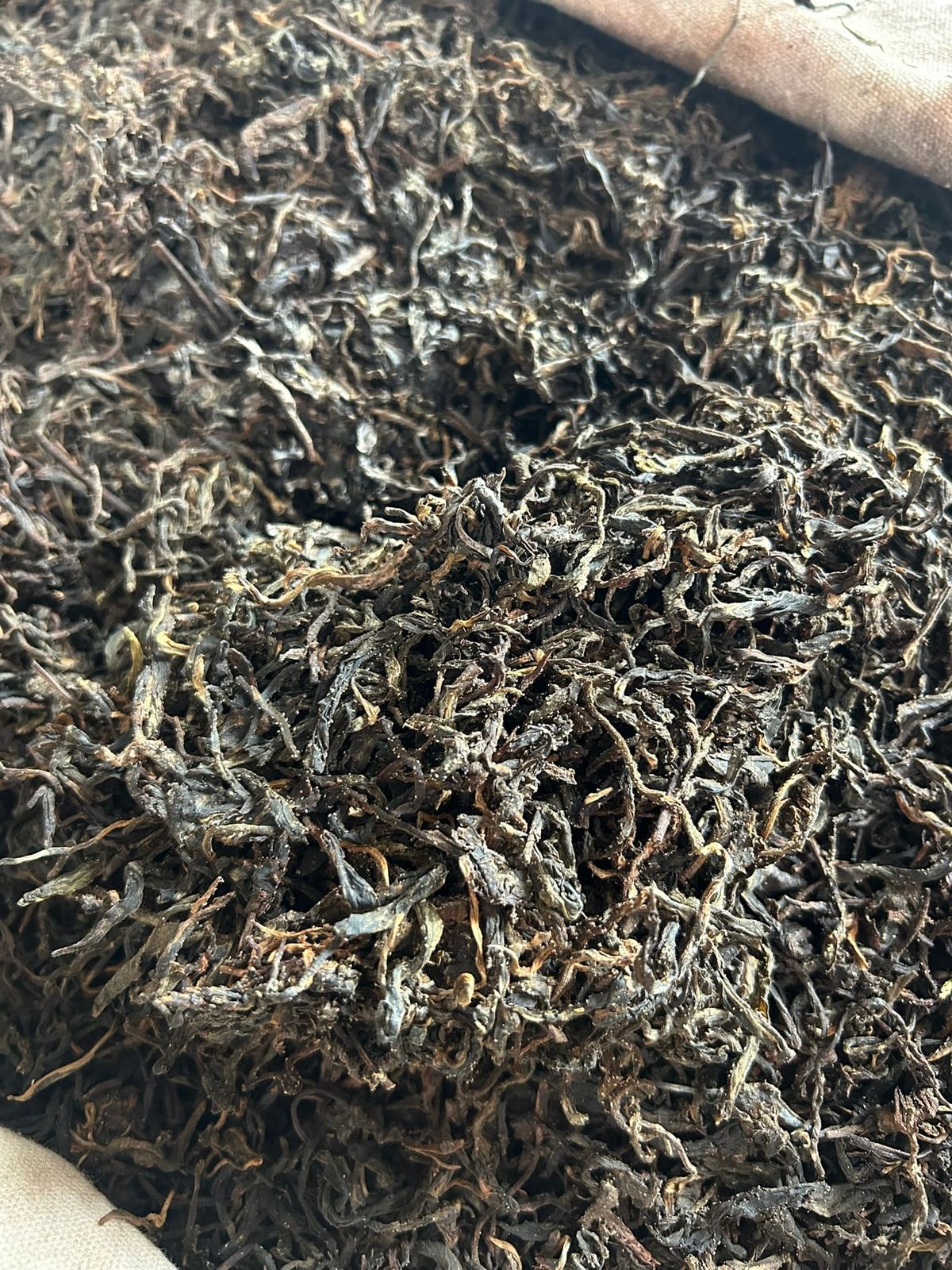
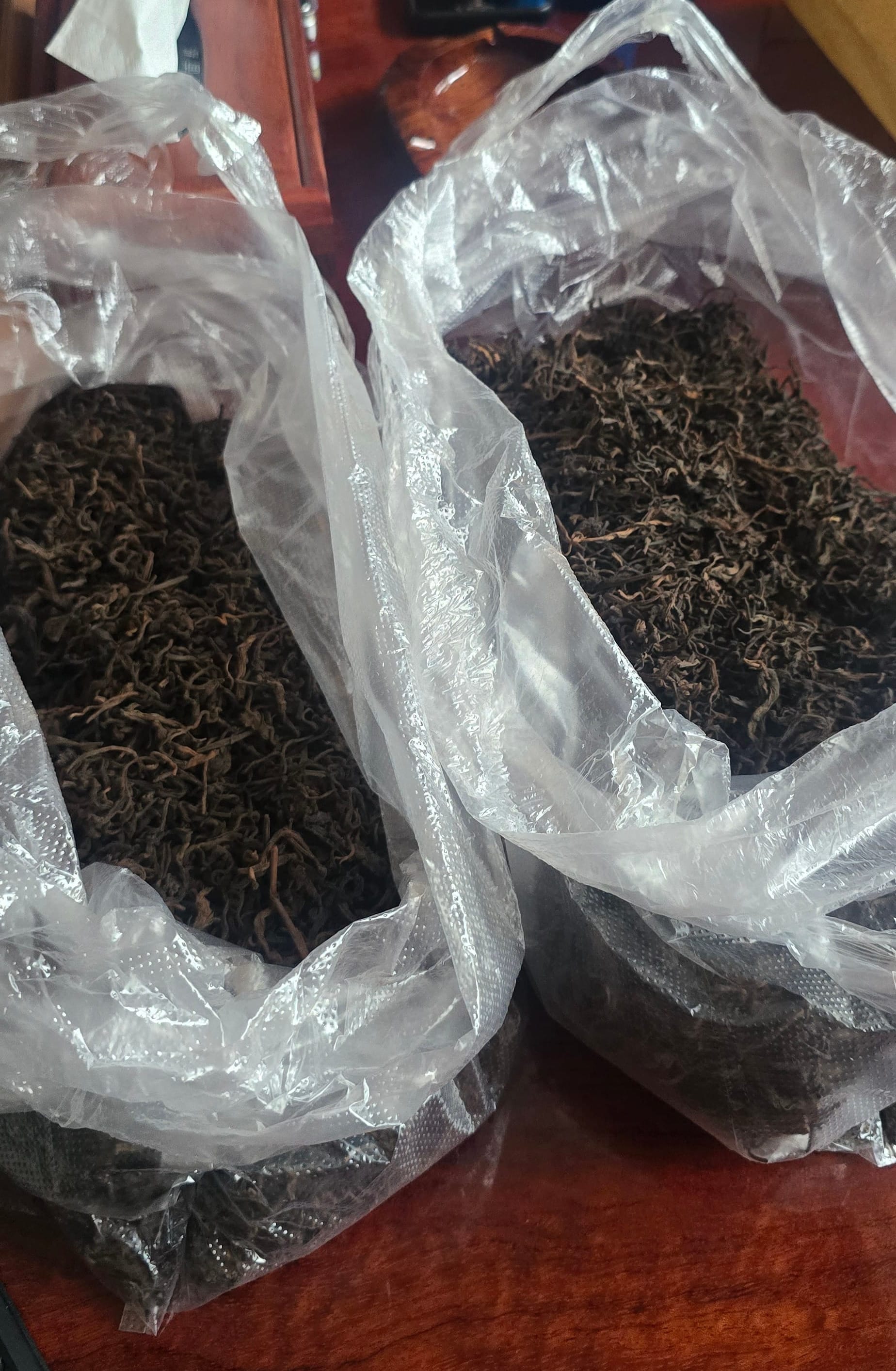
The first building we popped in to was a 7 stories high concrete box, and it looked like a standard Asian middle school. Instead of hallways, classrooms, lockers etc., each floor was one giant room approximately 100 yards long by 15 to 20 feet wide and was filled with literal tons of shou pu’er. The pu’er was piled in waves with troughs and peaks to allow airflow through the piles. Wetter piles were stored at the top of the building (with heat rising), while drier piles were stored towards the bottom of the building. We were told each floor contained one-hundred metric tons of tea. When asked, our local contacts said that many of the warehouses we saw in the areas we’ve been to were almost entirely for shou pu’er production. This floored me as we had seen hundreds of buildings, which napkins out to tens-of-thousands of tons of shou pu’er. Where is it all going? Who’s drinking that much commodity shou? Our guide was the mother of the producer. She handed us a literal trash bag and told us to grab what we wanted… needless to say we didn’t make a dent in their commodity supply.
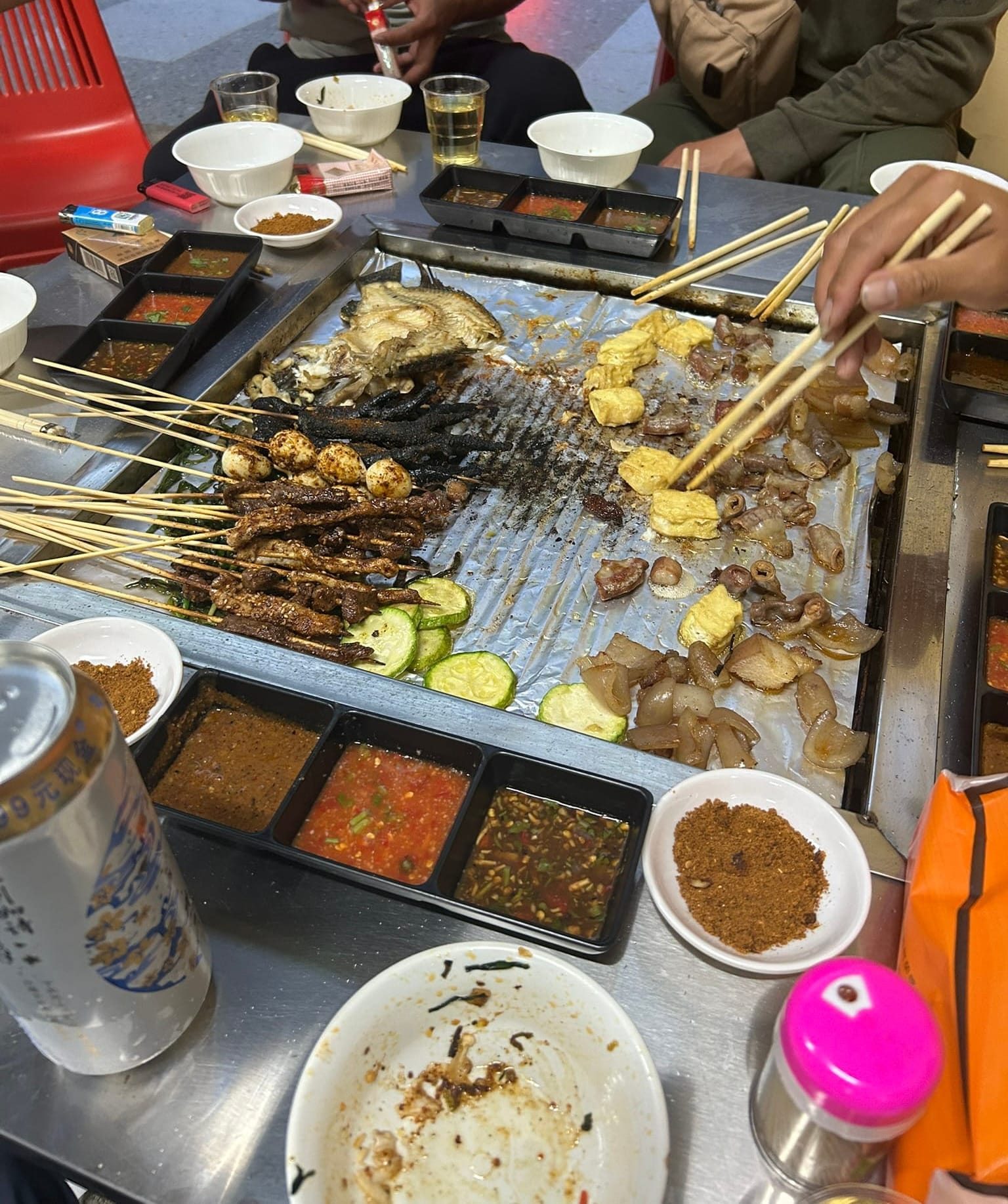
The following shou factory visit was after a long night of shao kao, Budweisers, and a glass or two of local moonshine more than was strictly necessary. Our bodies were in a sorry state, and we quietly made prayers of gratitude to the tea gods that our morning was to be spent sipping on shou and not Lao Man’E kucha (苦茶). We spent some time with a producer who had worked for Dayi (大益), and with cup after cup of warming shou, our stomachs slowly unknotted, and the fog in our heads washed away.
We took a walk around the processing facility where I got to see first-hand just what gave shou its smooth flavor and relaxing qualities. It’s mold guys: Mold. The answer is mold. Mold Alert! Moldy, moldy, mold.
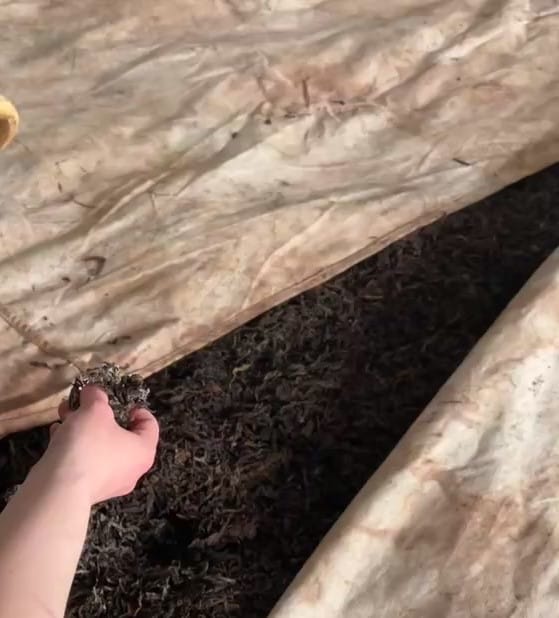
If you’ve never heard before: shou pu’er is fermented. While I knew this, and as a food scientist who has fermented products myself, I was aware of what actively fermenting molds looked like. I don’t think I was prepared for just how moldy shou pu’er is in processing. Unfortunately, the Shou facilities didn’t allow photography of certain processes to protect their trade secrets, so in lieu of a good photo of said mold: imagine touching a pile of tea, now scribble all over your hand with black sharpie, and imagine that’s what your hand looked like when you took it off the pile of shou tea. The sharpie is mold. Our hands were covered in fluffy, down-like clumps, of various Aspergillus species including Aspergillus nigers.
You need to really feel the fermentation to get a feel for the fermentation, so we did: the processor removed the tarp and we stuck our hands deep into a ~10 ton pile of pu’er that was fermenting on the floor. We pushed our arms into the pile, nearly up to our elbows before it got too hot for us to burrow any deeper. We were told the piles got up to 55° Celsius (131° Fahrenheit) in the center. As we pulled our arm out of the damp hot sticky mass, a bursting cloud of SO MANY SPORES, millions and millions of whiteish dots floating lightly on a waft of steam, filled the air, scenting us with a pleasant surprise. The aroma of stone fruits, wet rocks, and sourdough bread. I really didn’t expect actively fermenting shou to smell, well, good.
The processor also showed us some of the “off the floor” small batch wood containers they had but weren’t using; they said that they are available by request but floor fermentation is more controlled and by default superior. They stated openly that a lot of the innovations targeted at cleanliness produced less complex and lower quality shou. Nothing like floor and forearm sweat to give the little buggies something to work with.
This badass shou master looked like a man who could kill with a hammer. Thin shirt, gaunt frame, toned sinewy muscles rippling like an anger management problem. He manhandled the boiling hot gaiwan packed with what looked like 15 grams of shou pu’er, pouring with fingers directly against the body of the hot ceramic. This gentleman was a lighthearted and soft-spoken expert on all things shou – trained in the art of fermentation from the early factory days. Pure loving uncle material. Looks can be deceiving. This is what a life of drinking shou pu’er can do to you, I guess. He told us about the economics of shou pu’er (cross referenced with other producers): they have about 15-20% loss of product from fermentation and an additional ~10% loss through sorting, so taking a maocha and making it into ripe tea generally adds a 30% cost increase in processing overhead. As an example, he shared that some of the lowest end raw materials for ripe go for 30 RMB/kg ($4 USD per kg), after processing it can sell for about 68 RMB/kg (approx. $10 USD/kg) – almost a 2x in price due to processing overhead. He also gave us a brief insight into the main microbes and fungi that ferment pu’er which we would get much deeper into during the next factory visit later that afternoon.
We drove all of 15 minutes to the next ripe factory, passing a few hundred thousand kg of shou along the way. This factory was much newer, and the brand had a more modern take on shou pu’er. The factory started in 2021 but was built on years of scientific research into inoculating and controlling the main fermenting agents of shou pu’er, including aspergillus species (predominantly niger), penicillium species, Lactococcus and Lactobacillus, and a variety of yeasts. Depending on the moisture content and temperature, most shou pu’er fermentations will naturally go through different stages of fermentation where one type of either mold, bacteria, or yeast strain is the dominant fermenting agent. However, this facility pitches microbial cultures in order to influence, enhance, or change the natural evolution of a shou pu’er’s fermentation, much like a brewery or winery will pitch yeast to kick start fermentation to encourage a repeatable and enjoyable end-product. Or maybe more accurately how a sake brewery will pitch Koji mold spores in order to free up fermentable sugars from rice starch for yeast-based fermentations.
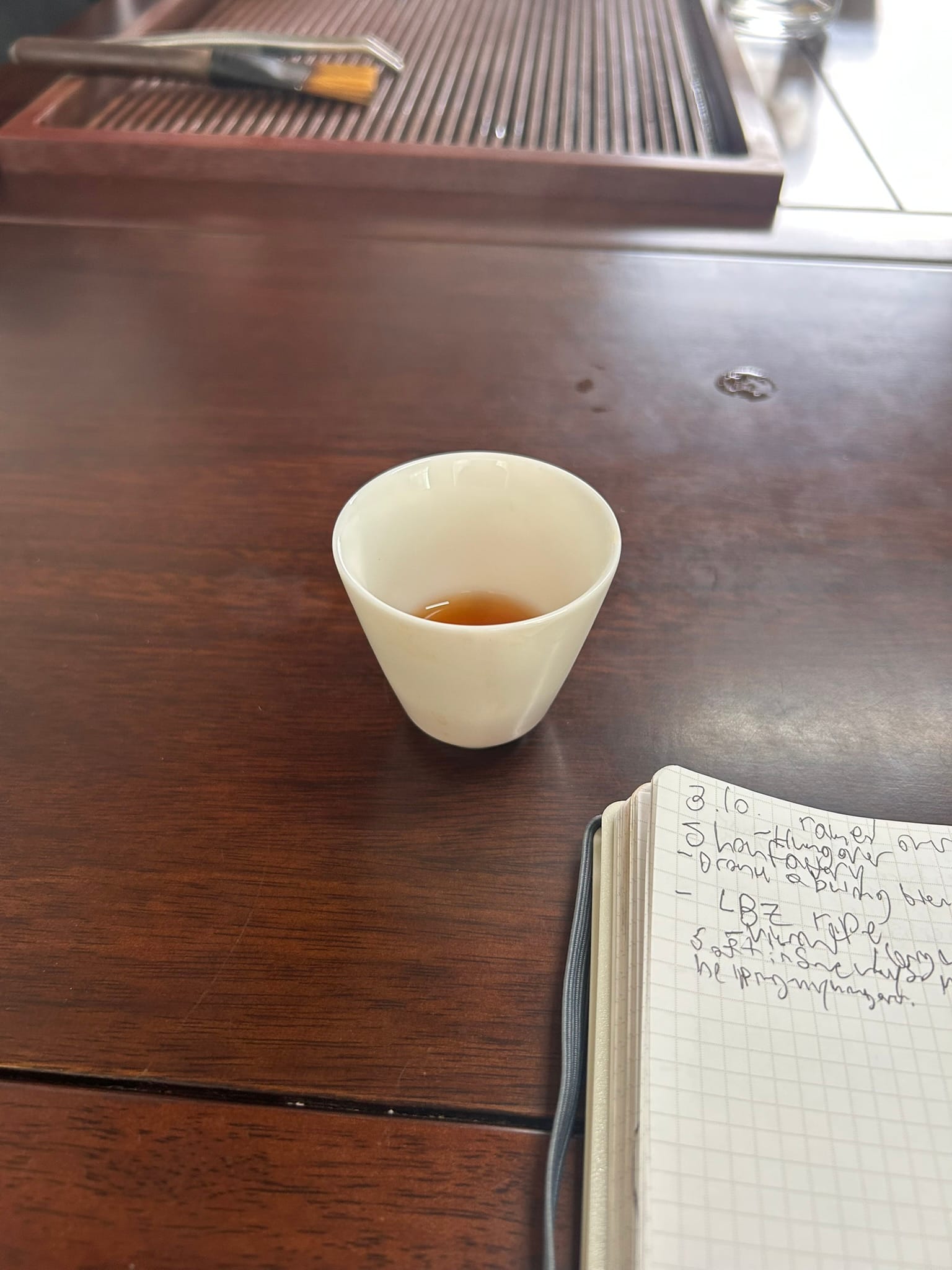
We drank a few productions with specific pitched microbes. The Aspergillus pitched shou tasted… well familiarly “shou-pu’er like”. It had the signature depth of color, richness of body, woody core, and while not immediately apparent to me – I was told Aspergillus dominant fermentations result in a more floral profile. We had a Lactobacillus forward ferment which was sweeter and breadier but didn’t have much origin character. We finished with a yeast dominant Yiwu shou which was particularly fruity and had a sourdough-like aroma to it. As an interesting side note we were told almost all Yiwu shou has some Bulang (布朗) material blended in to it (including the tea we were drinking), which was validated by our Yiwu contacts who claimed that single region fermentations didn’t achieve the complexity of flavor that a blend of regions could achieve (this is something we heard repeatedly about shou pu’er from every processor we visited). Touring the production facility showed a slightly more modern approach. We donned PPE to enter the facility, were not allowed to step in certain fermentation areas or contribute any forearm sweat to the piles, and saw that almost all fermentation for this facility was done off the floor.
Before leaving for the gushu gardens in some far-flung mountain you’ve probably never heard of, our contact offered to take us to lunch – a local spot up the road famous for donkey. I thought he was joking, or maybe it was a mistranslation (horse is pretty tasty). But after round and round of pounding back dark shou it was time to eat some donkey (you know what I wanted to write there 😉).
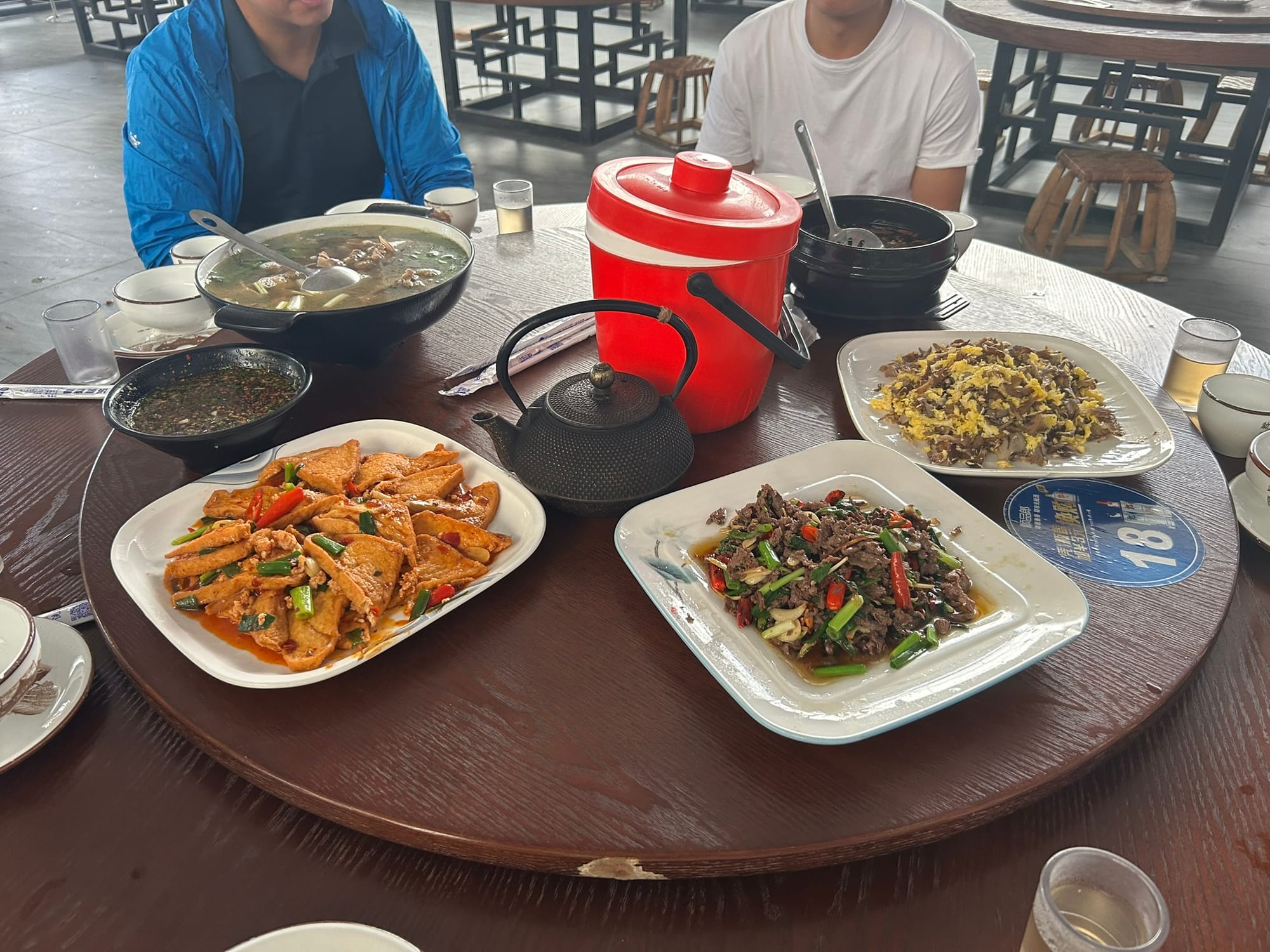
Donkey is a meat I never plan to eat again, and it was in every dish this lunch. The meat is pungent, chewy, oily... the flavor sticks with you, a gaminess you can’t quite shake. We had at least three preparations of donkey, stir-fried, braised, and oil-poached, which really served to highlight different aspects of its off-flavor. We tried to kick it up a notch like Emeril with a little and then a lot of little Guy Fieri’s Donkey Sauce (local chili oil) – and BAM – it had no effect; may as well have been Ass Kickin’ ranch. Paired with gamey mushrooms and fragrant oil, the meal clung to us for hours, on our palate and clothing. It wasn’t the worst thing we ate in Yunnan and doesn’t come close to rat-tartar in Wuyi, but it wasn’t good.
It was quite the local spot, and the owner and her staff were paying special attention to our table. They liked our blond hair and large Hebraic schnozzes and weren’t afraid to show it. I guess when you eat donkey everyday you grow bold. They asked us to leave our pants behind which is some rachet Yunnanese slang for something other than denim – and while I know ball, my accents a bit more Ri(日)ben than valley Dai, so I left it to J-Dog to do what must be done, and we got out of there before making an ass of ourselves.
Our final shou factory introduction came via a friend we met in Yiwu last year. He has a small personal tea brand and works with a processing facility in Menghai city, bringing them his raw material and specifying the level of fermentation for each commission, leaving the rest of the details to the experts. We drank a few interesting cups of tea together, including a multi-region cha tou (茶头; compressed solidified little shou nuggets from the bottom of the pile) blend, Laotian gaogan (高杆) single tree (yes single tree) shou, and a Lao Ban Zhang shou. All of us agreed that the single tree and single region shous, while interesting, lacked the depth of character the larger multi-region blend had. The processor told us that single tree shous are particularly difficult to manage as a single tree doesn’t have the range of substrates in the leaf to provide a robust fermentation matrix, but additionally that smaller batches (<1 ton) also struggle to achieve the degree of fermentation they traditionally aim for. In the processors’ opinion a larger batch fermentation will often outperform a smaller batch of better material. We walked from the table to their dry storage, which was an old basketball court, complete with photos of all the greats lining the wall. I think this shou’s particular processing notes were special due to the watchful gaze of Michael Jordan, Kobe Bryant, and characters from the anime ‘Slam Dunk’. Lastly, we moved on to their piling facility, another non-descript warehouse.
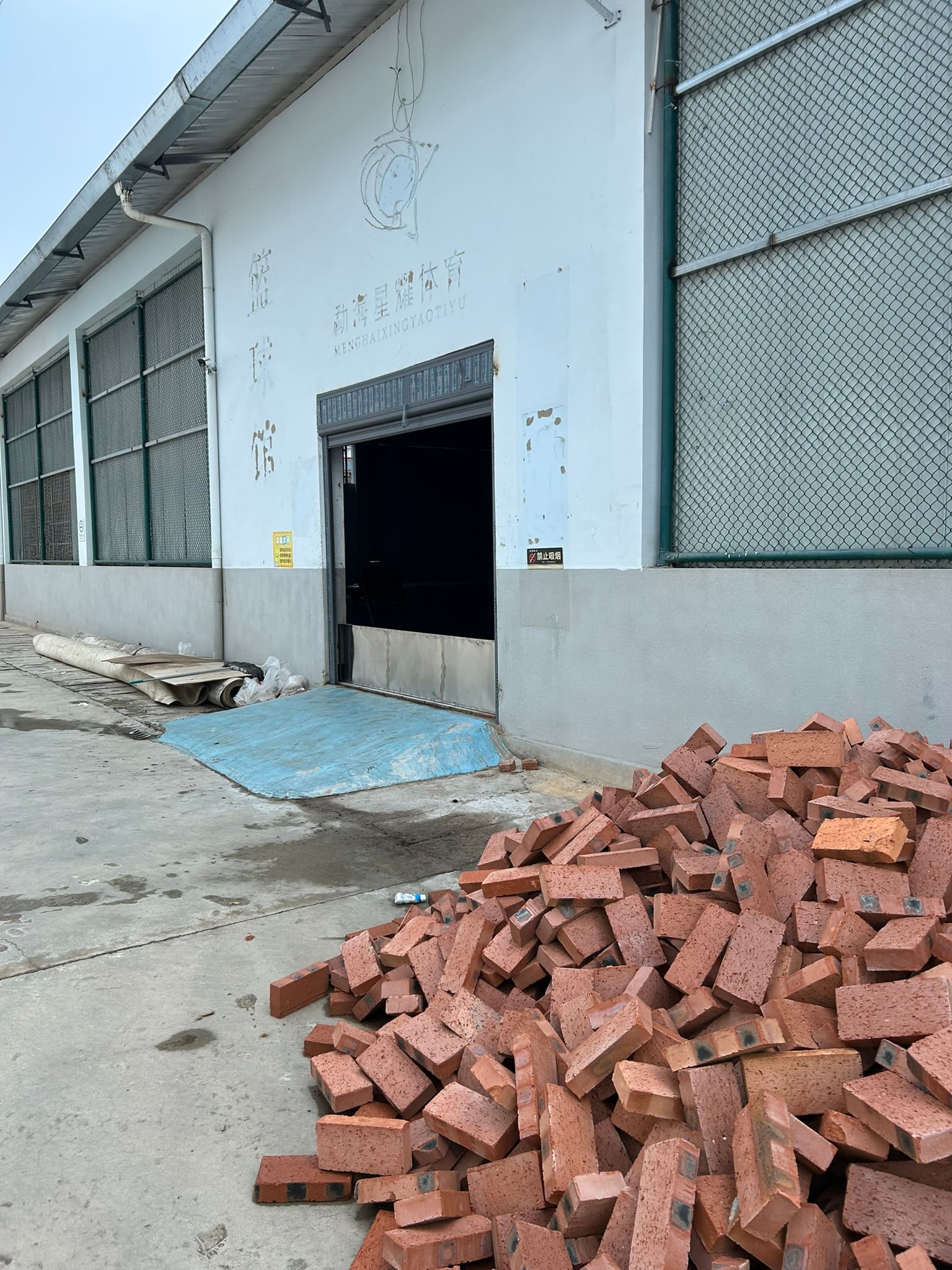
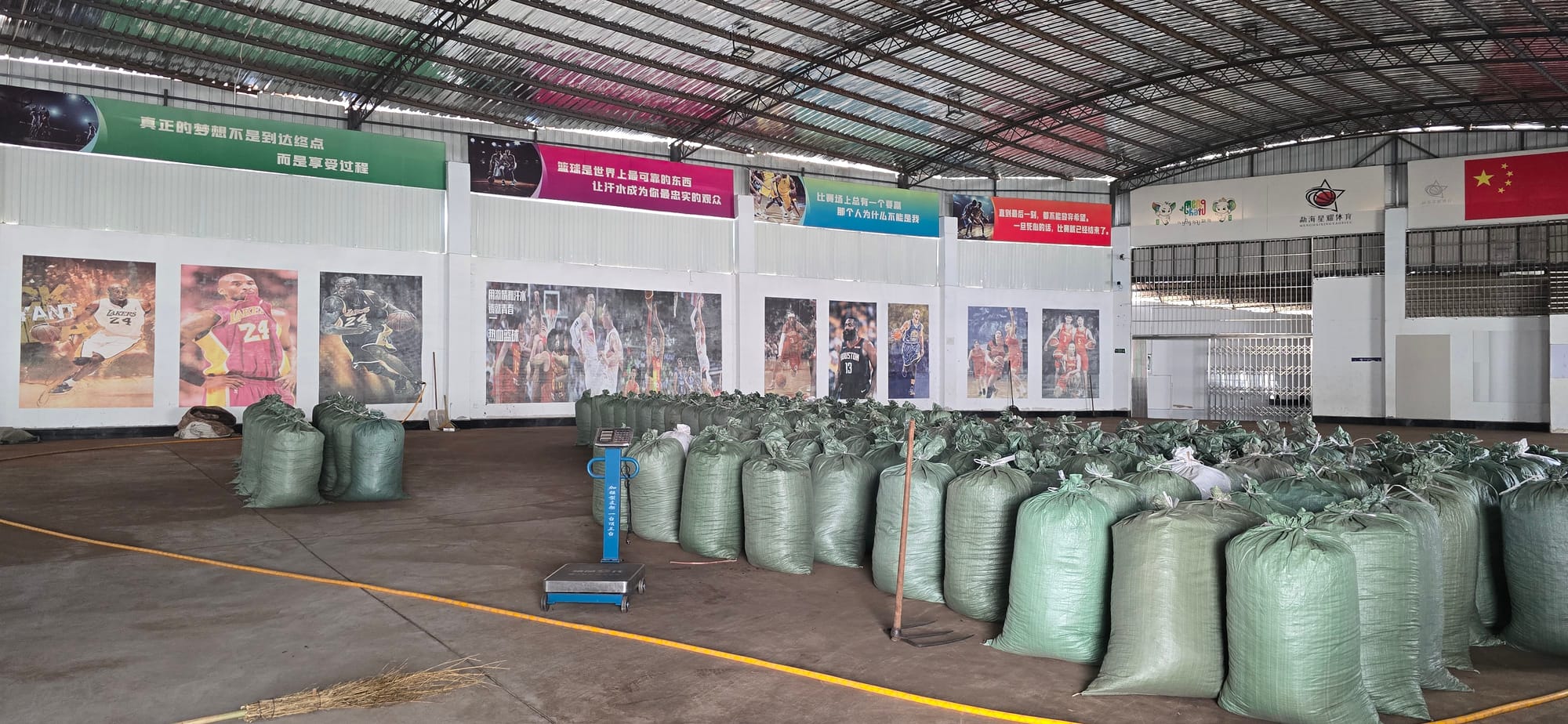
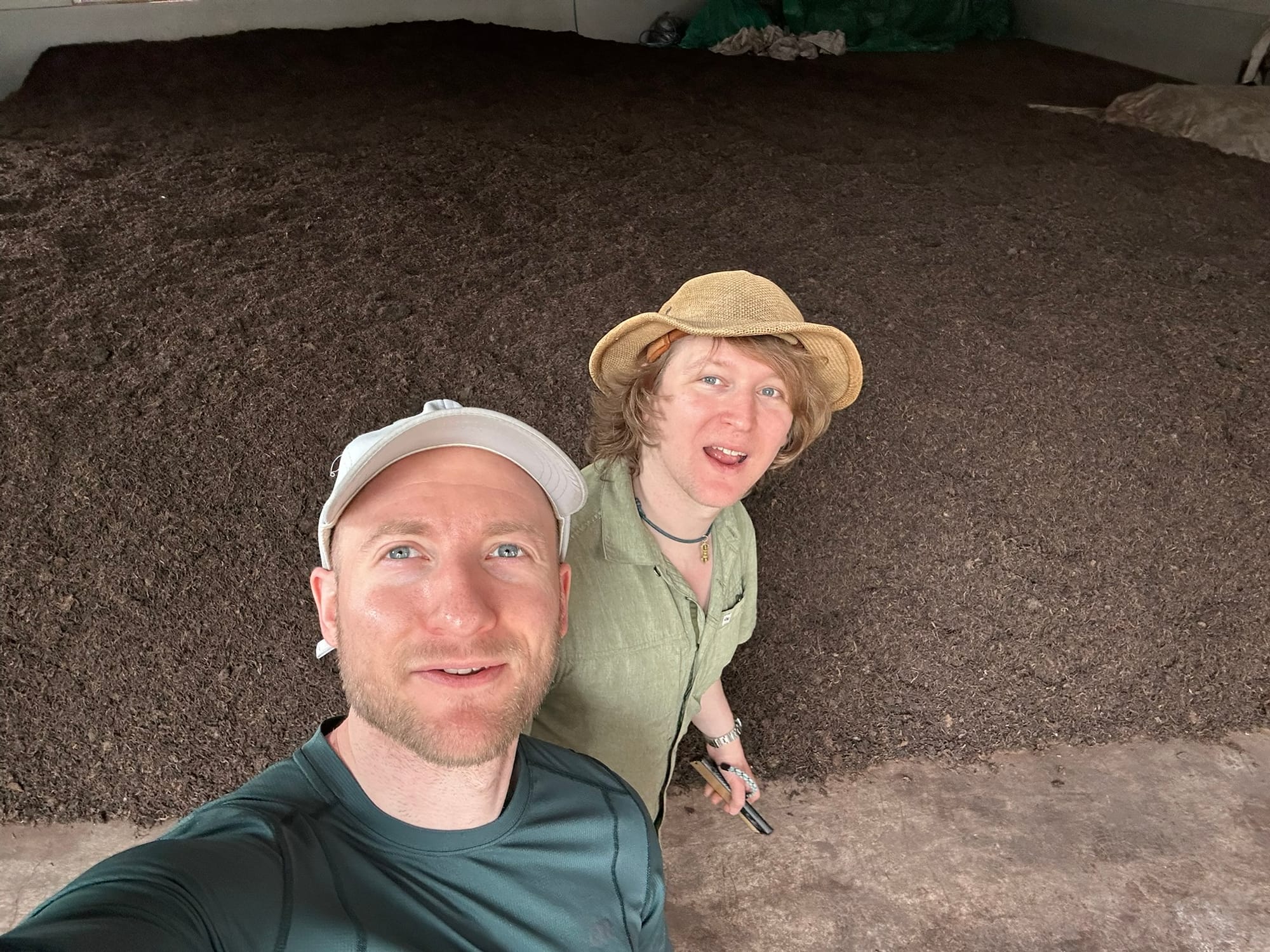
We finished this tour with a couple cups of a LBZ huangpian[2] (黄片) shou, discussing the differences in speed (and degree) of fermentation of Huang Pian. Huang Pian contains a different makeup of substrates (higher sugars), resulting in a faster fermentation, and overall lower degree of fermentation while still tasting ‘complete’. This can be done in as little as 17-18 days. The processor told us they shoot for the dry season (winter) for piling Huang Pian shou.
While I’m not leaving this trip any more of an avid shou drinker, I do think I’ve come to appreciate the importance of blending in shou, the different ideologies in processing (new school small batch on raised beds vs old school big pile floor ferments – and I didn’t land where I expected to on this point), and Menghai area teas’ role in the flavor development of shou as well as Menghai City’s’ role in shou pu’er production. I won’t be chasing down single tree hyped village small batch shou releases anytime soon, and who knows – come next winter you might find me sipping on a Bulang five village blend from one of the many major factories. For this, my stomach and my wallet will be happy.
[1] Wodui (渥堆) – the most common English translation I’ve seen is “wet piling”, this is the process by which pu’er maocha is transformed into shou pu’er. Through the addition of water, microbes like yeast, mold, and bacteria actively ferment substrate in the tea leaf, producing fermentation by-products that change the color, flavor, and aroma of the tea. Wet piling was one of the techniques explored in the 1960s by CNNP at Menghai Tea Factory in an attempt to create pu’er with a profile suitable for many of it’s southern Chinese and southeast Asian export markets. The technique was adapted from processing steps used with other heicha like Liu Bao.
[2] Huang Pian (黄片) refers to yellow, mature leaves, which are a by-product of pu’er coarse processing and are often separated out during production. Mature leaves have a different moisture content and contain a different mixture of compounds than tender buds, resulting in a different taste, color, and importantly – price point.