High Modernism in the Ancient Arbor: Tea Technique Research Trip 2026 – Menghai, Yunnan - Part 1
The more you know, the more you know you don't know…
- Not Aristotle
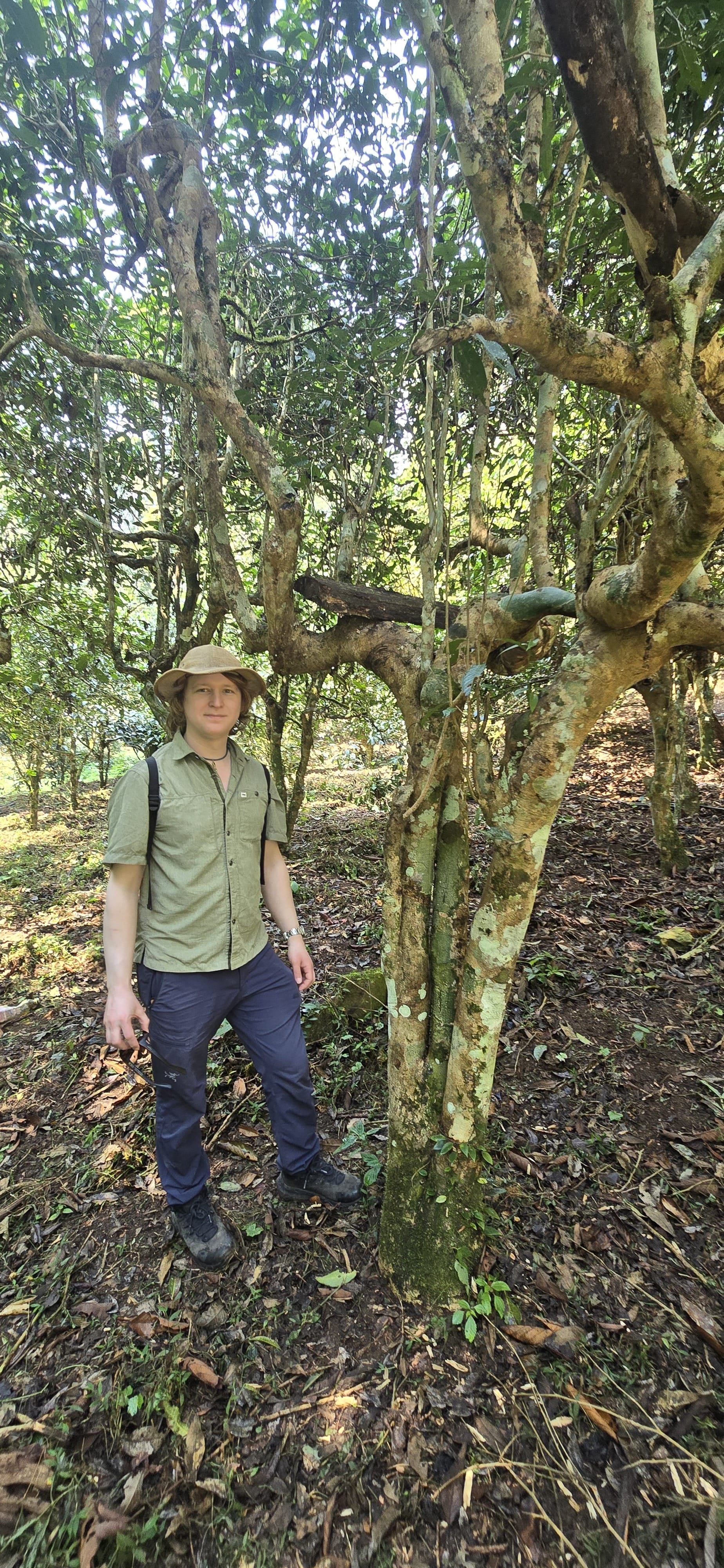
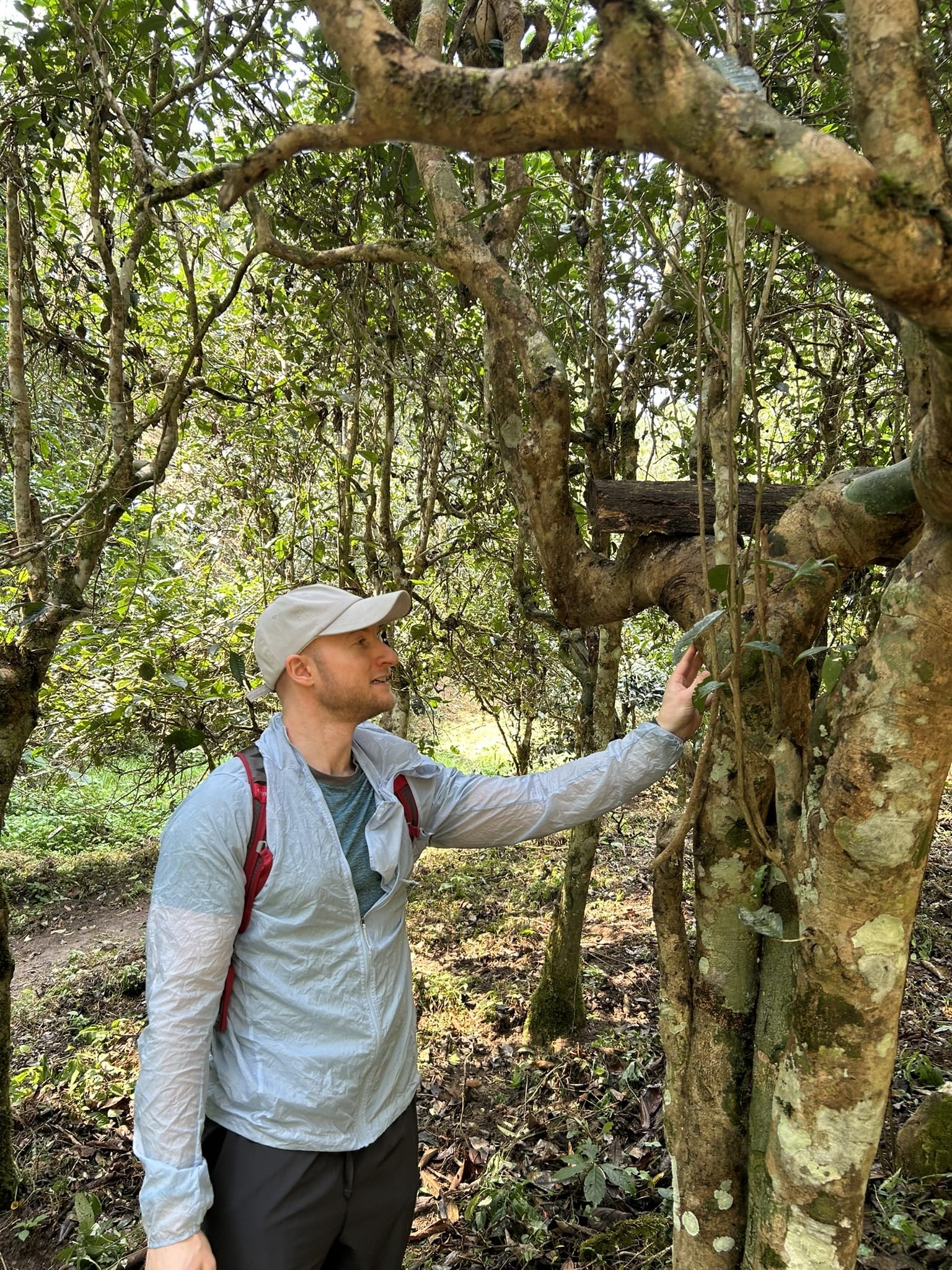
Jason & Pat on TTRT2026. These two high-t-high-tea bros have insta cred from our glamor shots with the #gushu tree. #TeaTechnique #LBZ #FRFR. All photos Tea Technique Research Trip 2026 – Menghai, unless otherwise noted.
Tea is a jianghu[1], a field of fractal complexity, where each hard-won fact contains shades of truth and applicability. 19 years into this journey, I thought I knew something about Menghai and its pu’er tea – only to find many missing pieces with sharp edges and opaque insinuations hindering clear insight. The Tea Technique Research Trip to Menghai opened a lot of questions on topics I hadn’t previously considered in any depth or detail, questions around: the regionalized variations in agronomy and arboriculture, the lasting impact of ethnically stratified cultural history on production practices and market structure, and the effects of high modernism on the very concept of pu’er. Of course, the trip also crystallized many insights on topics I’ve spent nearly two decades pondering, including ecology, terroir, and cultivars, in addition to the fermentation process of shou pu’er, variations in the production process of sheng pu’er, and what differentiates good tea from great tea. These trips are not designed as confirmatory research: despite the extensive planning, we arrive like precocious children, with hundreds of questions and the intent to ask them repeatedly of different people, gauging the variations of answers across context and location. There is a method to our madness and a madness to our method: so much of the in-field learning and experience is predicated on what we find and what we clue-into in the moment, and our ability to follow the thread to the end of the knowledge branch.
This year, I spiraled deep into questions about agriculture rooted in our on-the-ground findings, causing conditional re-contemplation of my consciously held conceptions of gushu (古树, “Old Tree”), forest tea, and quality. The forests in Menghai are managed, with interventions ranging from minimal to extreme: what accounts for these variations in the practice of agronomy and arboriculture? Why do different indigenous ethnic groups maintain different distributions of practices? How do those variations affect the brewed tea’s quality and aging potential? And does heavier intervention in the forest environment change the meaning of “gushu” tea?
These questions and their answers are nuanced; the developmental history and causal reasoning are often not apparent to the individuals who inherited practices from their family and village, and much was changed in their or their parents’ generation during the Communist Period and later through privatization and pu’er’s contemporary boom time. Many of the changes were, at various times, imposed top-down by the central, provincial, or prefectural government, making Menghai a classic case of High Modernism in action – and throughout this trip report, I argue that modernism is the force that created and shaped every component of cultivation, production, and market structure for pu’er tea. In the case of Menghai’s tea industry, the heterogeneous groups involved on the receiving end of various modernization campaigns were generally willing participants, who in some ways, benefited from the change. That may be changing as we enter a post-modern period where prior modernization campaigns come to be seen as short-term mistakes with long-term ramifications by consumers, if not uniformly by the farmers themselves. Menghai produces a lot of very low-end plantation tea and mid-grade arbor tea; it also produces a tiny amount of great forest tea. To raise our collective consciousness of Menghai and its range of pu’er tea, we need to examine the High Modernism of the forest, production process, market structure, and local culture; and contrast the modern forces and values that have shaped its recent history with our contemporary post-modern ideas and ideals. This trip report is what I wish I knew before going to the tea mountains of Menghai. Though, as they say, the journey is the destination.
Menghai, Ancient and Modern
Modernity in Xishuangbanna
Modernity can be defined by the industrialization of production and consumption: the breakdown of subsistence farming and local trade, the rise of capitalist market structures, the resulting division of labor, and the belief in technological progress through the application of science on naturally arising organizations or processes. The cultivation, processing, and merchandising of Menghai pu’er was modern in its origins, a market product built on resource extraction, ecological intervention, and commoditization through the application of various externally imposed High Modernist interventions. These interventions were often introduced under the guise of scientific and government programs aimed at modernizing all aspects of pu’er production, including its ecological and social environment.
High Modernism[2] is a statist ideology holding blind faith in science, technology, and the benefits of rationally designed society or nature; it is the belief and resulting policies that society and nature can be ordered, organized, and improved by comprehensive central planning, with decisions made by experts appointed by the government. Yet governments and their experts operate at various levels of abstraction, setting policy, measuring inputs, and taxing outputs based on simplifications without regard to local variations[3]; setting policy based on abstractions require simplifications aimed at legibility: the replacement of locally adapted systems, traditions, and methods fit to the people and place from which they arose, with standardized, measurable, and modernized systems and methods. High Modernism attempted to replace traditional systems that look chaotic, primitive, or illegible, with idealized and standardized inputs linked to easy-to-monitor and tax outputs. High modernist systems were often imposed by force, with the intention to bring contemporary scientific understanding and technology into practices viewed as backwards and traditional, without full regard or understanding for the natural evolution of complex systems that, over time, grew to fit the unique properties of their environment. Traditional farming and agroforestry are complex systems that arose to fit the specific ecological niche and human needs for its practitioners, for which high modernism has repeatedly proved disastrous – destroying ecosystems, agrosystems, traditional culture, and indigenous knowledge.
High Modernism replaces the farmers’ mētis, the practical, local, embodied and indigenous knowledge of the place, with an external episteme, an untested philosophical truth, that fails in practice: applied to farming and forestry, High Modernism resulted in the collapse of Prussia and Saxony’s planted forests, the starvation of Soviet citizens after farm collectivization, and the catastrophic soil depletion of Tanzania. In all of these cases, external government appointed experts brought new techniques of plowing, fertilizing, and monocropping to bear on delicate ecosystems that were previously self-sustaining; after replacing the older illegible yet ecologically balanced system with newer modern methods, the ecosystem required ever larger contributions of external inputs, synthetic nitrogen fertilizers, lime, irrigation, pesticides, and herbicides, to remain productive for a short time until its exhaustion and inevitable collapse.
Menghai is a place where High Modernism was imposed and resisted, attempted and abandoned, incomplete in its vision and execution; Menghai is a place succeeding and suffering from the mix of success and failures that are still playing out in the tea fields, forests, and markets, as our post-modern culture has turned sharply against the High Modernist ideals of plantations, monoculture, and inorganic inputs.
Why did Menghai develop in this way, did it have any choice in the matter, and was its transformation from pre-modern to modern inevitable? As we will see, in the case of Menghai, its descent into modernism was willingly accepted by the ruling classes in the valleys and incentivized economically throughout the region; its progression into modernism pre-dates the government policies and interventions that characterize statist High Modernist policies, instead originating in market structure and the ancient antecedents of people, place, and politics.
Throughout this trip report, comparisons to Yiwu contextualize the different developmental path, cultural history, and causal mechanisms for modernization in the neighboring yet contrasting regions. The Lancang River divides the prefecture of Xishuangbanna into the tea regions of Menghai in the west and Yiwu (mostly Mengla county) in the east. These regions are known for differences in the climate, soil, and cultivation history of the gushu pu’er gardens and their resulting flavor; just as the Gironde estuary divides the vineyards of Bordeaux into the strong-flavored, tannic and structured wines of the left bank, and the softer, sweeter, and more ethereal wines of the right bank, so it is in ’Banna: Menghai is believed to produce strongly flavored teas with structure and tannic bite, while Yiwu is believed to produce softer, sweeter, and more nuanced teas. While suitable as a first order abstraction, in tea as in wine, such generalities hide as much as they reveal.
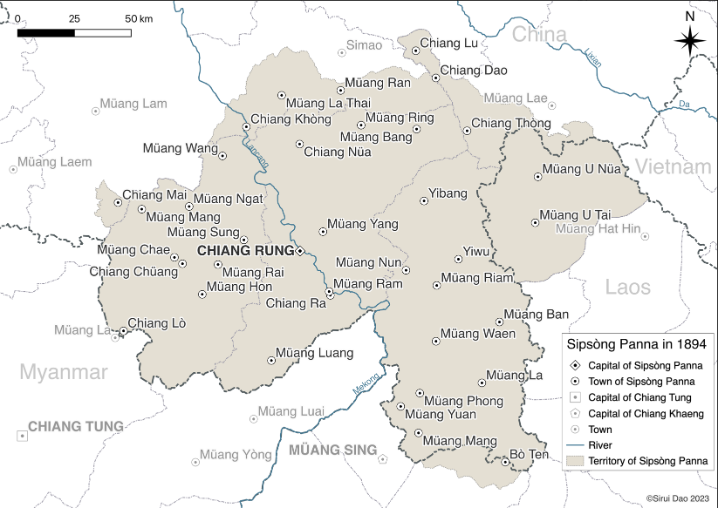
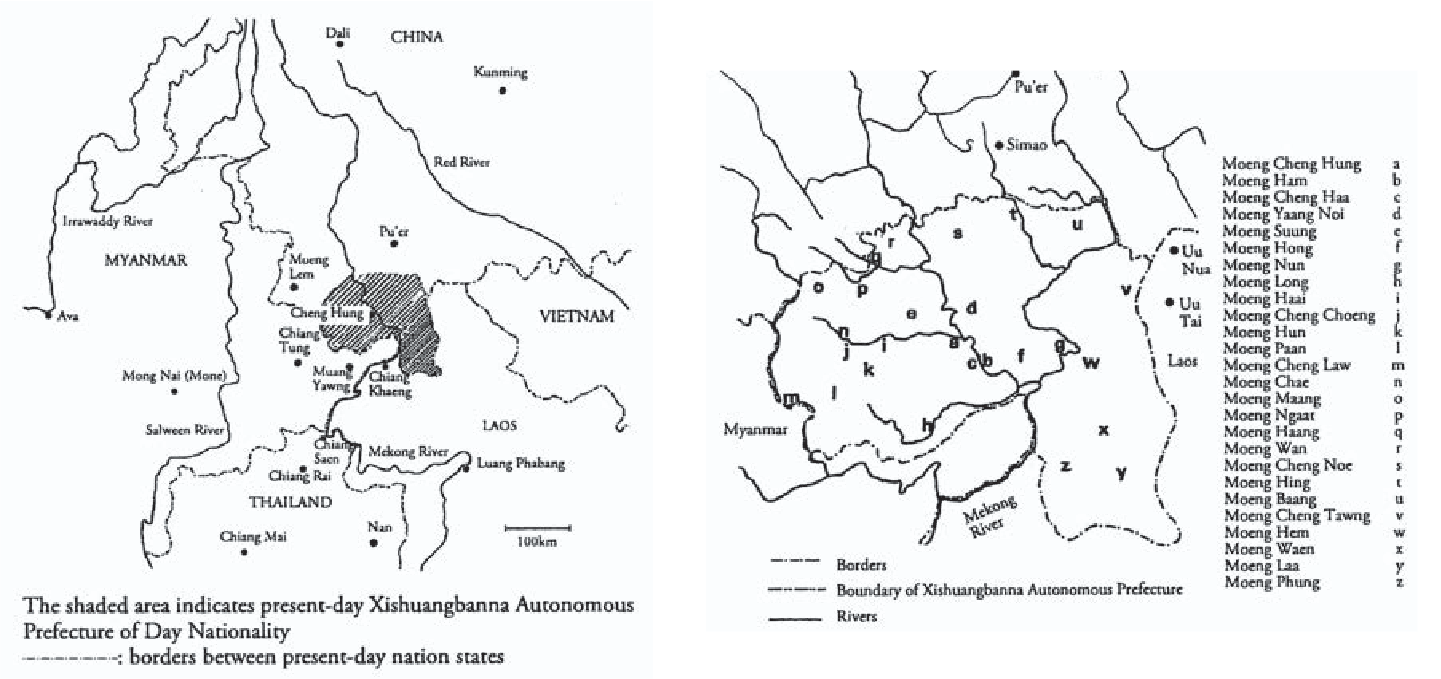
Xishuangbanna is the southernmost prefecture of Yunnan province, bordering Laos and Myanmar (Burma), not far from the border with Vietnam; the region is home to various indigenous groups, populating the river valleys, foothills, and subtropical mountains. Even after Xishuangbanna was conquered and partially integrated as a frontier region in the Imperial Chinese system under the Yuan dynasty in 1296 CE, the prefecture was at various times more integrated into the Burmese Imperial system, sharing a political, linguistic, and religious culture with various nearby Southeast Asian states[4]. Through the Ming and Qing dynasties, the region was under joint control of China and Burma, with the local Tusi lords enthroned in a ceremony with representation from both governments; the lords and the majority of their subjects were ethnic Dai people, living in the valleys and lowlands of Xishuangbanna[5].
By the late Qing, Xishuangbanna was divided into about twenty-odd small princedoms (勐, meng; Mueang in Dai language), each run by a hereditary lord (召勐, Zhaomeng; “Lord of the Mueang”), most of whom were directly related to the Dai “Lord of the Land” (召片领, Zhaopianling) who ruled from present-day Jinghong[6]. While the Tusi had nominal lordship over the various mountain tribes within their domain, and the Tusi themselves were nominally aligned with the Chinese state, these tribal lands and people were only partially integrated into the Chinese governance and economic system; the long arm of the Tusi and Chinese government often fell short of the mountain villages. Confucian ideals and the Chinese political system had little impact on the polities within Xishuangbanna until the late 1800s[7]. The confederation of princes was always relatively loose, and by the 1900s the principalities only had nominal allegiance to the Zhaopianling. Xishuangbanna’s Tusi governance continued through the Republican government of the RoC until its abolishment under the PRC in 1953 CE.
Polities and Pu’er
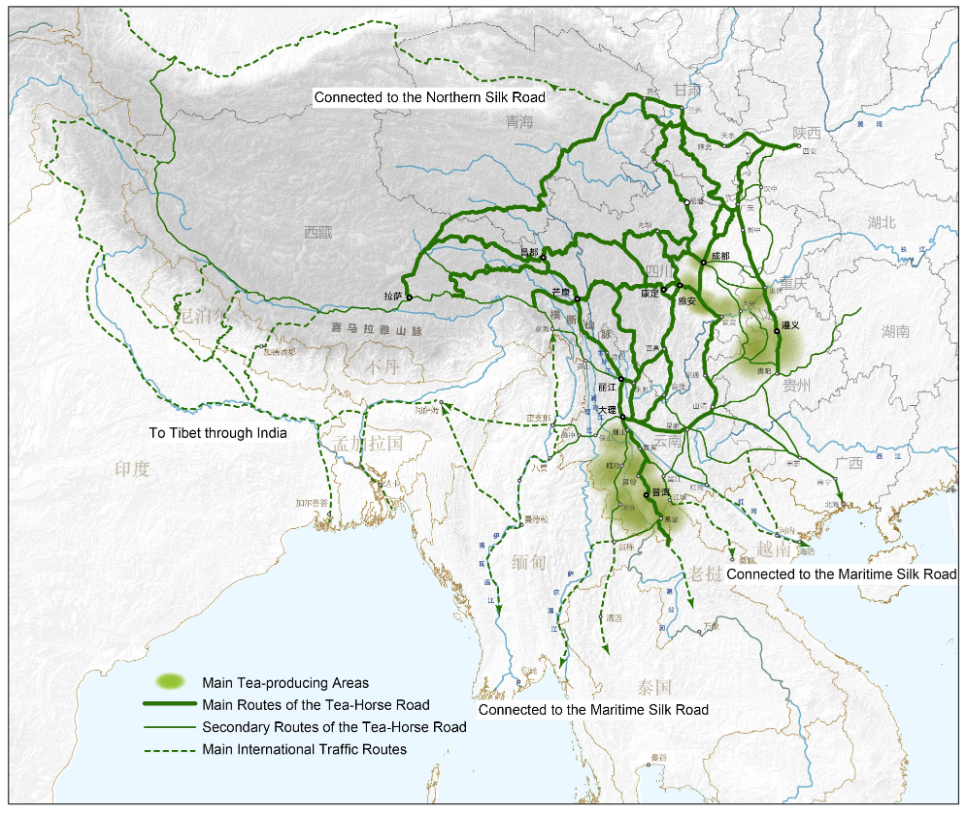
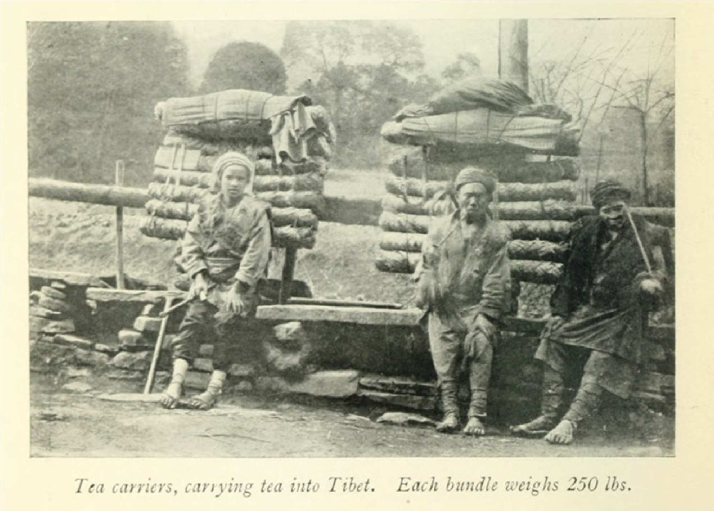
Tea cultivation in Yunnan dates back to time immemorial; many of the gushu groves were cultivated over a millennia long period spanning from the Tang through Qing dynasties. From its earliest origins, tea from southern Yunnan was a minority product for minority people; generations of Yi, Hani, Jinuo, and Bulang people[8] cultivated tea in various modalities, as a pickled spice, herb, medicine, beverage, and trade good. Tea was independently cultivated for consumption multiple times across southern Yunnan, as far north-west as modern Lincang and as far south-east as Laos. The Book of Southern Barbarians (蠻書)[9] by Fan Cuo (樊綽, fl. c. Xiantong reign, 860 – 874 CE, Tang dynasty) records the ancestors of the Yi ethnic group (and, more broadly, Nanzhao's descendant populations including the Bai ethnic group) boiling tea leaves with Chinese cassia, Sichuan peppers, and ginger for drinking[10]. With the rising popularity of tea consumption throughout the Sinosphere in the Tang and onward, the tea of Xishuangbanna was cultivated and processed as a product for export through progressively integrated overland caravan and maritime trading routes. By the Qing dynasty, the major consumers of Yunnan tea were the Tibetans[11], the Qing Imperial Court, the Cantonese, and various groups in Southeast Asia[12]. Tea traveled overland by horse, donkey or yak, and to ports in China and Southeast Asia by ship. The teas of Xishuangbanna were known by many names within the Chinese, Tibetan, and southeast Asian trade, differentiated by production method, compression, and shape. The umbrella term “pu’er tea” arose as a short-hand referring to all of southern Yunnan’s tea traded through Pu’er town[13], the centralized Qing dynasty taxation and trading post for Yiwu region teas, itself named after the ancient Pu (濮) people believed by some to be Yunnan’s earliest tea cultivators. The major markets for “pu’er tea” were always far from its origin.
Five of the “Six Famous Tea Mountains” of Yiwu[14] (all except Mansa, which is Yiwu Mountain itself) were controlled by the Ethnic Han Tusi of Yibang, the political center and administrative seat of the Yiwu region until its decline in the late 1800s. The Tusi of Yibang was held by the Cao (曹) clan, who by oral tradition claim Sichuanese ancestry, a merchant family who immigrated to the region during the Kangxi period to trade tea. The progenitor of the clan married a Yi headsman’s daughter and subsequently assumed the tribal position, with each subsequent generation marrying into another tribal headsmen family to institutionalize long-term political control; Cao Danzhai was the first imperially recognized member of the clan, made Tusi in 1729 CE after supporting the Chinese in quelling a local uprising[15]. Cao was later made the procurement officer for imperial “Pu’er” tribute tea in 1735 CE. The Cao clan held the Tusi position for nearly 200 years, until its abolishment in the RoC (though the Tusi system itself survived another ~50 years or so). While nominally part of the Dai Zhaopianling domain, Yiwu was run under a parallel administration from the appointment of the Cao clan, aligned with the Chinese imperium and Confucian culture.
In the early Qing, the Imperial Household developed a preference for the lighter green-tea-like productions of Yibang mountain, accepting it as a tribute tea from 1729 CE (Yongzheng period) onward; the “Gongcha” tribute tea was bud-heavy, fragrant, and consumed fresh, produced from old arbor trees. Tea from Mansong village, on Yibang mountain, was the favored terroir[16] within Yiwu’s tribute tea. Qianlong wrote poems praising the “firm and robust” flavor of the “sparrow-tongue” tender buds[17]. In the late-1700s and early-1800s, the Emperor and Imperial family gifted princes, Mandarins, and Hanlin scholars this Gongcha “Pu’er”, making it a fashionable product amongst high-society[18]. Early versions[19] of Dream of the Red Chamber (紅樓夢, by Cao Xueqin, 曹雪芹, c. 1715 – 1763 CE) mentions the preparation of pu’er as a medicine for settling the stomach after a heavy meal, using the verb 熬 (ao; to decoct, to boil until reduced) in chapter 63 (壽怡紅群芳開夜宴 死金丹獨艷理親喪); this indicates that whole-leaf southern Yunnan imperial tribute tea, a green-tea adjacent production process, was prepared via light simmering, long after steeped tea had already become vogue for the high-end green teas and yancha’s in the late Ming, matching with the way in which Empress Dowager Ci Xi is said to have preferred her pu’er tea after consuming greasy foods. The medicinally inspired production process is likely based on the tea’s unique bodily effects[20] and its holding as “other” – a not entirely Chinese tea, sourced from the frontier.
Xishuangbanna’s “Gong Cha” tribute tea was made exclusively from early-spring first flush material, harvested before the grain rain (谷雨, guyu)[21]; it was illegal to pick and process tea for private sale before the harvest of imperial tribute tea was complete. In contrast to the bud-heavy Gongcha, “pu’er” tea not made for imperial tribute was likely composed of a more standard leaf-composition, ranging from 1-bud-2-leaves to no-bud and tertiary leaves, depending on village and merchant. The few literati who wrote of tea from Xishuangbanna in the early Qing all describe the liquor as strongly flavored, bitter, viscous, and often astringent. These were not exactly positive attributes used to recommend the tea to other literati and followed the majority literati view of proto-pu’er tea as a barbarian product: the late-Ming dynasty scholar Xie Zhaozhi (謝肇淛, 1567 – 1624 CE) in his book滇略 (Dianlue) wrote of local gentry and peasants drinking “pucha” (普茶), a steamed and kneaded tea pressed into shapes; he was unimpressed, writing that it tasted no better than water.
It was only later in the Qing dynasty that tea from Xishuangbanna became a recognized and marginally accepted product within China, after achieving minor tributary status, with few fans amongst the literati elites outside of Guangdong. Generations of Han Cao-clan Tusis, beginning under the Yongzheng reign, actively encouraged and recruited Han migration into the Yiwu mountains for tea cultivation and processing; the in-migration of Han people carried variations in seed-stock, particularly the small-leaf sinensis variety, leading to hybridization and further active cultivation of the indigenous landraces centered around Yibang mountain. The Han people were considered more skilled producers of tea by fellow Han traders, and their production was favored over trade with other ethnic groups.
雍正七年 (1729)… 在勐海, 猛遮, 易武, 倚邦等地设置‘钱粮茶务军功司… 当时普洱茶作为进贡的珍品, 吸引了不少汉商进入攸乐山在内的六大茶山种茶.
In Yongzheng 7 (1729 CE)… Offices for grain, taxes, tea affairs, and military merit were set up at places such as Menghai, Mengzhe, Yiwu, and Yibang… At that time pu’er tea, as a tribute luxury, attracted quite a few Han merchants into the six tea mountains including Youle to plant tea.
- 张梦婷, 從土司領地到自治州:國家與邊疆互動背景下西雙版納的社會變遷 (From Domains of Tusi to an Autonomous Prefecture: the State-Frontier Interactions and the Social Transformation of Xishuangbanna). PhD diss., The Hong Kong Polytechnic University, 2020.
The Yiwu region (inclusive of Yibang, the main settlement before the rise of Yiwu town) prospered and expanded after the Qianlong government relaxed the (short lived) state monopoly on the tea trade[22], leading to an influx of tens of thousands of Han migrants and merchants with skills in tea cultivation, processing, and trade; the majority of the migrants originated from the Shiping region of Yunnan[23]. In less than half a century, Han settlers planted on the order of 30,000 mu (亩)[24] of new forest-gardens for tea cultivation[25]. Writing in 1799, the official Tan Cui (檀萃) described the six tea mountains as teeming with hundreds of thousands of laborers and merchants, filling the roads with caravans for the transport of tea[26]. The Yiwu region was thus the origin and heart of the Xishuangbanna tea trade throughout the dynastic period; while both Yiwu and Menghai regions produced tea and were home to indigenous minority groups with histories of tea cultivation, it was Yiwu that cultivated and processed tea prized for drinking in the Chinese style, acceptable to pockets of merchants and mandarins within the Sinosphere.
In contrast to the centrality of Yiwu throughout the core dynastic period, Menghai is the late arriving center of pu’er production and trade, the trading post of a hinterland indigenous product originating in distant mountains under the control of semi-sovereign native chieftains who swore cheap dual allegiance to the Chinese Emperor and Burmese King[27]. Menghai town (勐海; originally called Fohai (佛海)) arose in the early 1900s as a processing and trading center for tea cultivated west of the Lancang River, undercutting the two northern trading posts of Pu’er and Simao. The bulk of trade to Tibet shifted from the northern route (beset by bandits, Chinese military requisitions of mules and occasionally able-bodied men, and bribes to be paid at overland checkpoints) to the southern route from Menghai into Burma[28] from where it was often transported by sea to India and then overland to Tibet, which offered safer and faster passage. The decline of Yibang village and Pu’er town occurring in parallel with the shift in trade patterns allowed Menghai, previously a non-place, to become the center of processing, warehousing, and trading of pu’er tea by the early RoC, with various multi-ethnic merchant networks establishing caravan routes to Hong Kong, Thailand (Siam), Vietnam (Tonkin), Burma, and Tibet[29].
The People of Menghai
In Menghai, the lowland people are Dai and Han (with a lot of in-migration from mountain villages in modern times), while the upland people historically cultivating tea are Bulang, Hani, Lahu, and Jinuo; the ethnic settlements are stratified by altitude: lower elevation and mid-mountain slopes were settled by Bulang and Hani, the mid-mountain to high mountain slopes by Hani, and the higher more-marginal peaks were settled by Lahu. The valley Dai[30] still form the majority of the population in Xishuangbanna (though not in Yiwu), a contiguous ethnic group stretching from Myanmar through northern Laos and Thailand, and formed the ruling ethnic-class of the Tusi system (except again in most of Yiwu). Lower-class Dai working the land of the feudal lord often planted tea on the lower slopes surrounding their villages; these plantings were never a major component of dynastic period tea and were derided as low-quality “valley tea” in their time.
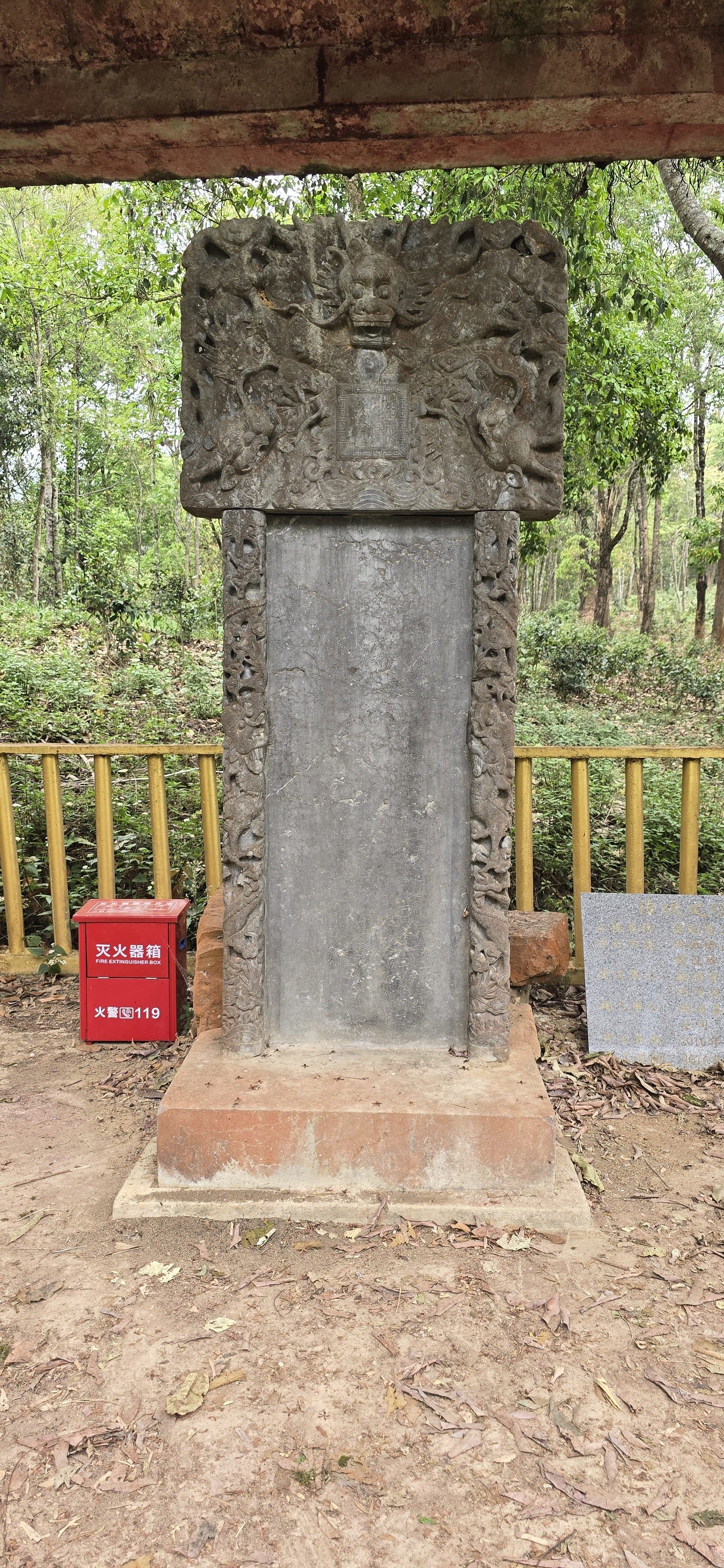
The Bulang people have a history of cultivating, consuming, trading, and venerating tea trees, and have maintained cultural taboos against felling or harming tea trees through the modern period; tribal rules on tea cultivation and tree protection were recorded dating as early as 1,700 years ago. Before tea arose as a common beverage in the Tang, Bulang people pickled tea leaves for family consumption and gifting, in addition to its use as a medicinal plant. By the Tang dynasty, certain Bulang settlements were producing tea as a beverage, for consumption and trade, alongside its earlier indigenous usage-patterns. Laoman’e is likely the oldest Bulang settlement in Menghai: a stele dates the founding of the village to 639 CE, in the early Tang dynasty, lending credence to the generally accepted claim identifying the Bulang (or their ancestral Pu) as the original planters and cultivators of tea in Xishuangbanna. It has been argued[31] that the concentration of kucha (苦茶) tea in Laoman’e is an outcome of purposeful cultivation by the indigenous Bulang population, and not merely an endemic genetic predisposition; this interpretation appears to match the historical protection and use of the kucha gushu trees.
The Hani were not the original planters of their ancient tea gardens in the mountains of Nannuo, Pasha, Banzhang, or Hekai, and the oldest tea trees of these subregions long pre-date the arrival of Hani settlers. The Hani arrived in Banzhang circa 1476 CE[32] and were granted the land and forest resources by the subregion controlling Bulang tribal elders based in Laoman’e; it was the Bulang (or their Pa tribal ancestors) whom are believed to have planted tea across various mountains throughout the Menghai region, before abandoning certain village sites such as Laobanzhang. The Lahu came to tea cultivation later than Bulang or Hani in southern Xishuangbanna, developing their own management style on the marginal mountain peaks; trees planted within the village and coppiced at lower height for easier picking and possibly for wind protection. The Jinuo people likely originated in the Simao region, migrating south through Yunnan until establishing permanent settlements in Youle mountain northeast of present-day Jinghong by the late 1100s CE; tea production likely dates earlier than is attested to in Chinese sources, beginning in the early 1700s[33].
Menghai’s Pre-Modern Tea Market
In the pre-modern era, Menghai (unlike Yiwu) maintained a partial monopsony on tea production enforced by the Dai government; minority groups (and lower status Dai) with tea lands were required to sell their tea production (via village headman) to certain Han-owned tea companies. By the RoC, the tea-merchant association negotiated the price for tea internally, allocating sourcing districts to each merchant; the merchants then presented their monopsony price to the village headman (often bearing gifts to ease the pre-determined price). The headman then presented the year’s price of tea to the villagers, slightly lower than what was agreed with the merchants, pocketing a small middleman’s profit. Individual farming families could not sell their production to individual merchant-traders, reducing incentives for quality differentiation or the development of new harvesting techniques. While extractive, the merchants needed to maintain a baseline of support and viable harvest economics for tea production, limiting their monopsonistic pricing power; in fact, the merchants often paid 50% of the estimated harvest price to growers in advance, usually during the early spring, such that the villagers could fund their rice harvest. Merchants also brought Han tea making experts to Menghai to train village coarse processors, as part of their effort to create and improve production standards. This monopsony system coexisted with more feudal arrangements of taxation or corvee labor in the Yao and Jinuo villages of Youle mountain, where taxes and rents were paid directly to the Zhaomeng Dai lord.
Merchant-traders and tea brand owners engaged with the down-mountain Menghai tea-trade (“fine processors”) were likewise predominantly Han. Many of the tea companies were owned by local officials, who, as elsewhere in China, believed that their investment and commerce within the region was indicative of good governance. The Han tea making companies generally leased land from the Dai and formed long-term purchasing agreements arranged with the local Zhaomeng lord and various up-mountain village headman. To an extent, the monopsony of the Han as tea-leaf buyers and the monopoly of the Han on processed tea sales was enforced by de facto government rule, supralegal to statute. In Yiwu, by contrast, the Han tea making companies generally intermarried with the village families to secure their supply of tea.
The pre-modern tea of Menghai was distinct from the 七子饼 (“seven-son round cakes”) proto-pu’er of Yiwu, a lower-end bulk product for export, disparaged by Yiwu merchants in the RoC as overpowering and bitter – though some used this cheaper material for blending into their Yiwu products[34]. Early Menghai producers (circa mid-1930s) specialized in紧茶 (jincha), mushroom-shaped compressed tea, predominantly sold to Tibet (via the southern Burma-India route) with a minor percentage of the production transshipped to Burma and other Southeast Asian markets; while there were similarities between the products in the domestic market, there was relatively little competition between Menghai and Yiwu teas until the contemporary era. In the 1930s, Menghai tea produced for the Tibetan market underwent an additional process of moisture activated fermentation: the coarse leaf material destined for the inner core of the jincha was left dry (to prevent unwanted black mold)[35], while the higher quality outer leaf material was sprayed with water and left overnight before compression[36]; the compressed tea was then warehoused for about 40 days until dry, before packaging[37]. This process caused the tea to darken and often develop“yellow mold” (“黄霉”) or “pine-pollen-colored mold” (“松花霉”)[38]). This is distinct from the later development of wodui (渥堆) for pu’er by Guangzhou merchants in the mid-to-late 1950s and then widely implemented in Yunnan through the mid-1970s[39] (for the production of shou pu’er); in general, the use of these techniques is indicative of the type of lower-end tea products Menghai specialized in before the rise of boutique pu’er in the 1990s.
The Origins of Menghai’s Modernism
Tea plantations were first established in Menghai during the RoC (c. 1938 CE), beginning with the establishment of the Si-Pu Enterprise Bureau (思普企业局) Experimental Tea Stations in Mengzhe and Nannuo[40], a provincial-government-level project under Hui[41] management. Founder Bai Mengyu (白孟愚, also written白耀明) proposed a modernizing "border region plan" to the Yunnan provincial government, which included farms, a textile mill, brick works, a hospital, and schools in addition to the tea plantations and processing facilities; the plan was accepted and the development funded by the Yunnan Finance Department. Approximately ~100,000 mu of taidicha in neat rows of industrialized tea were eventually planted in Nannuo, most in cleared forest lands; additional government sponsored tea plantations were founded in 1939 CE.
This then establishes the antecedents of Menghai’s tea-field modernism: a feudal principality ruling an ethnically stratified tribal land, a center-periphery tea commodity chain where value accrued down-mountain and outside the region, and where the marginalized people welcomed state-supported development outside the Han-Dai tea monopsony. The people, place, and politics of Menghai embraced the emergent modernism of the new century, planting the seeds of high modernist state intervention, which grew like an invasive weed nary a decade from its rooting.
Modern Forest Management
The Menghai region packs an astounding range of environmental diversity into a relatively compact area, from truly tropical environs where banana plants fruit and flower next to old-growth tea trees, to the mid-altitude subtropical-jungle-plateau, and to chilly low alpine mountains where pine trees perfume the forest next to the tea trees. Menghai rises from an altitude of 525m in the river valleys to 2429m high at its peak; the environment is highly stratified by altitude, with the complex mountain topography forming localized environmental gradations varying from subtropical to subalpine within ~60km distance. Cold wind is blocked by high mountains in the north, while seasonal warm tropical winds pushed by the monsoon arrive from the south, nurturing gradations of terroirs suitable for tea.
Minimal arboriculture techniques were practiced by the upland ethnic groups involved in tea cultivation before 1949 CE, and there is no evidence of systematic branch cutting or pruning within Menghai or Yiwu[42] outside a few high-altitude Lahu ethnic villages (where tea trees planted within the village were coppiced) before the modern era. Agroforestry techniques were generally limited to light weeding, limited picking windows, customs around picking intensity, and the purposeful planting of diversified plant species ranging from hardwoods and fruit trees, to culinary and medicinal herbs, to plants with natural pest repelling effects (such as mint and certain species of Zanthoxylum) within the forest environment. The traditional agronomic practices extended to horticultural propagation: particularly good trees were left unharvested in rotating years, to support seeding for new plantings.
The Hani are said to have practiced a low-intervention tea shaping technique in certain areas including Nannuo and Pasha: by bending the main trunk down with rope or vines, a new branch would take over as the main upward growth, which would then likewise be bent down; repeating this process formed a tree of reduced height and many horizontal branches with secondary upward growth, all within easy picking height; this technique was occasionally paired with stone wedges placed at branch points, forcing branches to grow away from each other and serving as footholds for climbing pickers. The combination of these methods produced a low tree with large crown, resembling an umbrella shape (“伞型”)[43]. Such long-term low-intervention practices seem unknown today.
It is often tempting to project one’s own personal prelapsarian desires onto noble pre-modern minorities living in harmony with nature – though in this specific case, with regards to tea cultivation, that seems to be the case: tea plants were allowed to naturally grow and spread through seed, with occasional concerted planting efforts for the foundation of new gardens, and were protected from cutting or over-harvesting by village tradition. There is little evidence of any negative ramifications from the protection, spread, and harvesting of tea in upland mountain communities. A note from a Draft Gazetteer of Simao prefecture (思茅志稿, Simao Zhigao) quotes Qing dynasty scholar Ruan Fu (阮福, 1801 – 1875 CE), author of 普洱茶记 (Pu'er Chaji, "Record of Pu'er Tea")[44]:
思茅志稿云: 其治革登山有茶王树, 较众茶树高大, 土人当采茶时, 先具醴礼祭于此, 又云茶产六山, 气味随土性而异, 生于赤土或土中杂石者最佳, 消食散寒解毒。于二月间采蕊极细而白, 谓之毛尖, 已作贡, 贡后方许民间贩卖. 采而蒸之, 揉为团饼. 其叶之少放而犹嫩者, 名芽茶, 采于三四月者, 名小满茶, 采于六七月者, 名谷花茶, 大而圆者, 名紧团茶, 小而圆者, 名女儿茶, 女儿茶为妇女所采, 于雨前得之, 即四两重团茶也; 其入商贩之手, 而外细内粗者, 名改造茶; 将揉时预择其内之劲黄而不卷者, 名金玉天, 其固结而不改者, 名疙瘩茶. 味极厚难得, 种茶之家, 芟锄备至, 旁生草木, 则味劣难售, 或于他物同器, 则染其气而不堪饮亦… 历史上布朗族对古茶园做粗放式管理, 不施肥, 不修剪, 简单除草.
The Draft Gazetteer of Simao says: Within its jurisdiction, on Gedeng Mountain, there is a Tea King tree, taller and larger than the other tea trees. When the local people are about to harvest tea, they first prepare sweet-wine ritual offerings and make sacrifice there. It also says: Tea is produced on six mountains, and its aroma and flavor differ according to the nature of the soil. That which grows in red earth or in soil mixed with stones is best; it aids digestion, dispels cold, and resolves toxins.
In the second lunar month, extremely fine and white buds are picked; these are called maojian (毛尖). They are used for tribute, and only after the tribute has been fulfilled are common people permitted to sell them. The leaves are picked and steamed, then kneaded into round cakes. Leaves that have opened only slightly and are still tender are called bud tea. Those picked in the third and fourth lunar months are called Xiaoman tea; those picked in the sixth and seventh lunar months are called grain-flower tea. Large round ones are called tight-round tea; small round ones are called daughter tea. Daughter tea is picked by women and obtained before Grain Rain; it is the four-liang round cake tea.
When tea has passed into merchants’ hands and is fine on the outside but coarse inside, it is called remade tea. When kneading, if one first selects the stiff yellow leaves inside that do not curl, this is called Jinyutian. Those that remain hardened and unchanged are called lump tea. The flavor is extremely rich and hard to obtain. In households that grow tea, clearing and hoeing are carried out with great thoroughness; if grasses and trees grow beside it, the flavor becomes inferior and difficult to sell. If it is kept in the same vessel with other things, it absorbs their odors and becomes unfit to drink… Historically, the Bulang people managed ancient tea gardens roughly: they did not apply fertilizer, did not prune, only weeding around the trees
Menghai’s High Modernist era begins with the communist founding of CNNP in the 1950s, building on the plantation techniques pioneered a decade earlier by the Si-Pu Enterprise Bureau (思普企业局). Plantations were founded throughout the former lowland Dai gardens and accessible up-mountain tea village gardens; gushu trees were abandoned at best, trimmed into bushes, or felled for replacement by plantation tea at worst. Production of tea at the plantation level and trade in tea from the mountains was intermittently interrupted from the late 1930s through the mid-1970s by war and trade policy.
The level of intervention in forests and fields greatly increased with the introduction of the Transform the Old and Actively Develop the New Tea Garden (改造老茶园, 积极发展新茶园) policy in 1974 CE, under which the government promoted the replacement of old tea trees with modern terraced plantations, instructing villages to rip out gushu tea trees for replacement with terraced tea gardens. The policy was High Modernist in its economic, agricultural, and socialist goals: the production of more tea for export through the founding of plantations specifically described as “advanced” and “scientific” and the integration of ethnic minorities into the socialist collective system[45]. Under this policy, the Menghai region saw mass-plantings of tea plantations by the Dai in the valleys, which remains the source of many low-quality tea gardens surrounding Jinghong today; the initiative replaced almost all gushu trees in the lowlands. While the campaign was intended region-wide, it was never enforced in the more remote villages or forest lands higher in the mountains; the more remote and poor villages preserved their gushu trees precisely because of their poverty and location – their slow pace of development and lack of direct government intervention in the early-modern period prevented the destruction of what became a valuable commodity in the post-modern period. Not all up-mountain regions were so fortunate; the more developed and accessible mountains were included in the campaign: Pasha is said to have lost more than half of its ancient tea gardens extent in the 1950s[46].
The CNNP Tea Factories favored small and tender leaves, as was common in other classes of tea (such as various oolong and green teas) produced in Han regions; arbor material was devalued, as rustic and lower quality throughout this period. From 1974 CE[47] to the early 2010s, the vast majority of pu’er on the market was processed from plantation tea, the planting of which expanded continuously through the early 2000s. Minor amounts of up-mountain gushu tea from Menghai was integrated into later blends as a state-supported initiative to integrate the various minority groups into the communist collective system; to this end, systematic coppicing of old tea trees was a state-supported intervention program from the 1970s onward. In the 1980s, production yield from a single village’s old tea trees increased up-to ten-fold, from ~21kg per mu to ~260kg per mu within a few years of coppicing, after the application of external fertilizers; these methods were applied to over 100,000 mu of old tea gardens throughout Menghai by the year 2000[48].
The two major CNNP plantations located in Bada and the Banzhang subregion of Bulang, each named “10,000 Mu Tea Plantation” (now owned by the Dayi brand), were both opened for planting in 1987 CE[49]. Total area of tea plantation in Yunnan grew from approximately ~2,406,000 mu in 1990 CE to ~4,545,000 mu in 2007 CE[50]. This was a change from the earliest productions of CNNP, where the famous early factory cakes including Hong Yin (“Red Mark”; late 1940s – mid-1950s), were still produced using arbor material, likely from the Yiwu region, which declined further during the communist era and produced exceedingly little tea for the market from circa-1960 through the early 1990s. Yiwu was a far-off forgotten land, while Menghai was the center of new pu’er industry. Minor production of Yiwu tea, focused on easily accessible village trees, was available as early as the 1980s; Yiwu copied the techniques then prevalent in Menghai, coppicing many gushu trees. In the 1990s, the government plantation initiatives morphed into semi-ecological and social benefit programs, spreading up-mountain to the low hills where tea planting was used to prevent ongoing slash and burn agriculture[51]. All of these late plantings were plantation style flat-land or terraced gardens, using indigenous seed stock or new clonal cultivars developed by the Yunnan Academy of Agricultural Sciences Institute of Tea[52].
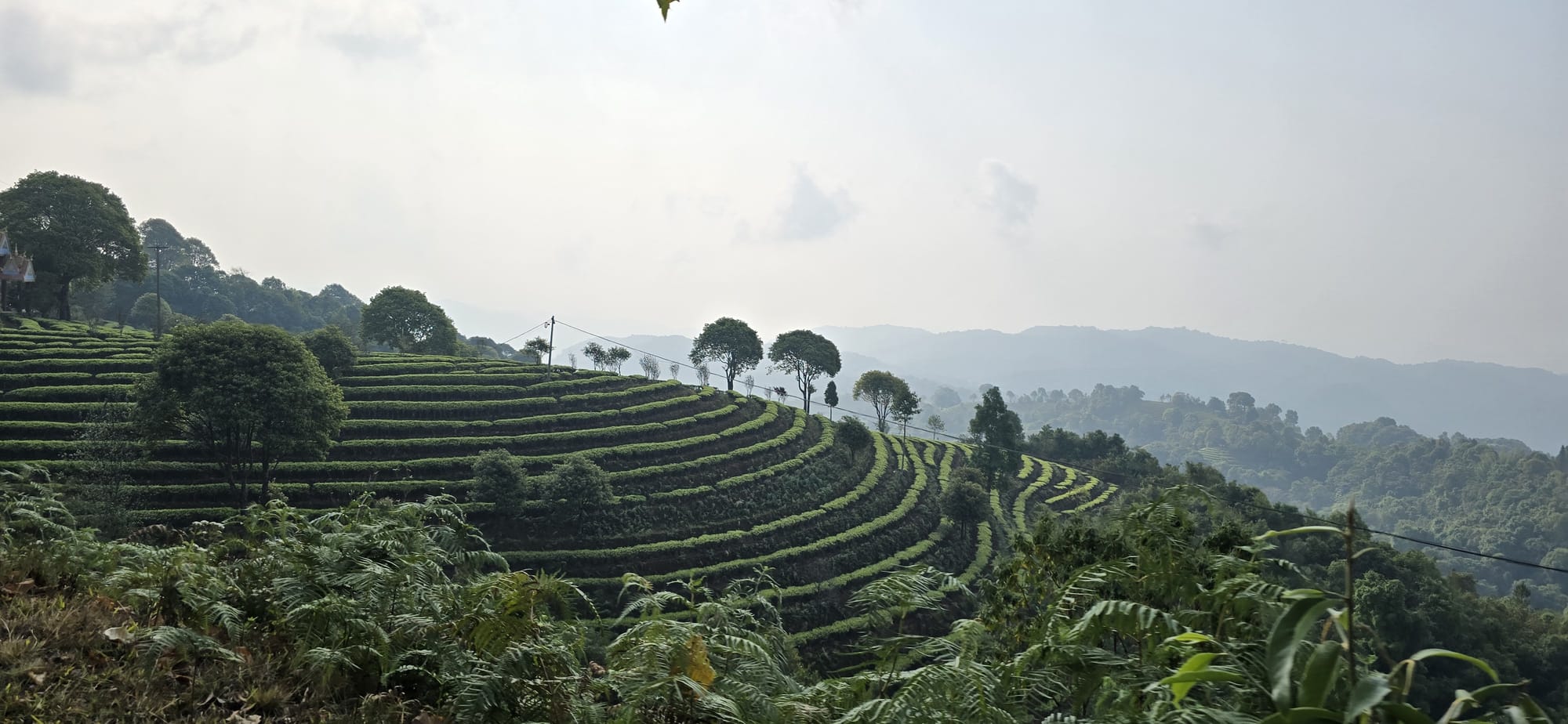
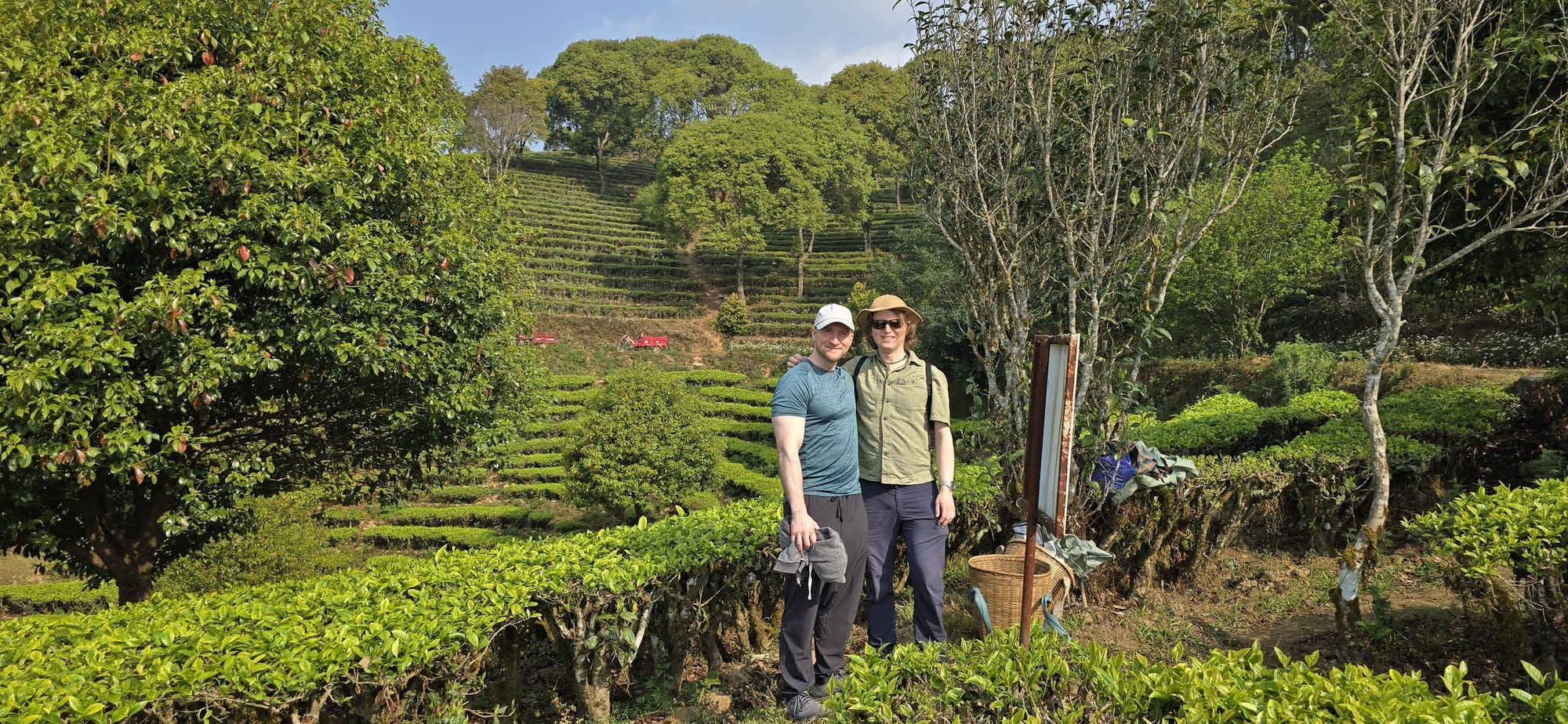
Dayi’s “10,000 Mu Tea Plantation” in Banzhang region, wassup factory bros? Photo of and by author, Tea Technique Research Trip 2026 – Menghai.
Taiwanese interest in pu’er surged in the 1980s, arising as a new-found “traditional luxury” for the newly wealthy island. The available stock of pu’er was comprised of aged teas, predominantly from second-hand trade to Hong Kong; trade between Taiwan and the mainland was limited and direct trade wasn’t available in the early days of the pu’er fad. The promotion and preference acquisition of pu’er tea in Taiwan was led by merchants: merchants held tastings, educated potential customers, and pushed aged tea onto an initially skeptical consumer base. Taiwanese merchants may have created the ideal of aging pu’er, given their access was almost entirely old stock. Fear of economic collapse and new restrictions drove Hong Kong tea merchants to sell off large holdings of aging tea before the handover in 1997 CE; with the preference for aged tea well established, Taiwanese merchants and collectors purchased huge amounts of the discounted warehouse holdings, further fueling the rise of aged tea as a new ideal for pu’er in the modern period. Yet with no new supplies of aged tea forthcoming, various groups of Taiwanese merchant-collectors sought new stock of age-worthy pu’er material, eventually traveling to Yunnan in the early 1990s. What they found was a government mandated collective, with few remaining links to its indigenous past, harvesting an overwhelming amount of plantation material to produce tea for the communist collective factory system.
Arbor pu’er production reemerged in Yiwu after 1994 CE, when a small group of Taiwanese merchants seeking to recreate the flavor profile and qualities of Hong Yin and other “masterpiece era” factory cakes traveled to their quest’s suspected origin, commissioning new productions of gushu material tea produced with revived (or re-invented) older production methods[53]. The earliest commissions focused on easily accessible arbor tea trees, usually near the village, and often those that had been coppiced in the 1980s. The subsequent patronage of the Taiwanese merchants, quickly followed by a new wave of Hong Kong merchants, reawakened the Yiwu tea industry. The use of arbor material for pu’er production spread from Yiwu to Menghai and beyond in the mid-to-late 1990s. Forest tea swung from originating to ignored to desired for its authenticity and quality; the average price per pound of forest-or-gushu maocha increased more than tenfold from 1999 (~35rmb/kg)[54] to 2007 CE (400 – 600 rmb/kg)[55].
Throughout its history, tea from Yunnan, including proto-pu’er, was an export product, a product for Southeast Asia and Tibet, a product for overseas Chinese, and a product for hard currency exchange[56]. With China’s reform and opening up in the early 1990s, pu’er tea transformed into a product of cultural heritage, an indigenous cultural luxury, a status signifier drawn from domestic culture available at every price point; the same transformation it underwent in Taiwan a decade earlier. By the early 2000s, appreciating pu’er tea from gushu teas or aged stocks has become a mark of refinement in certain circles. China’s modern consumerist culture closely matches that of other high-income countries: upper-middle-class individuals find distinction in embodied skill such as connoisseurship of affordable-luxury products, foreign (wine, previously coffee) and domestic (tea, contemporary coffee), from which they derive status. The ability to differentiate aged versus young sheng and gushu versus plantation tea is a learnable skill with a cache of cultural capital. This in turn has created the market for single-origin gushu teas, at a range of price points and qualities; pu’er is no longer a commodity for simple consumption.
Pu’er tea grew into a speculators’ market in the early 2000s, with aggrandized claims of ancient trees and aging potential; investors were sold on a dream of riches for those who bought early and waited. This was not to be. Much of the tea sold for speculation was low quality, often blended or pure plantation material, not worth the ink on the wrapper. Precious little real gushu existed, and the trade was quite small[57]. The bubble burst in 2007 CE[58], leaving the market flooded with unwanted low-end tea and potentially millions of mislabeled cakes of unknown provenance and storage.
While the price for taidicha never recovered, real forest tea (gushu and qiaomu) was relatively stable through the market turmoil and returned to growth by 2010 CE. The harvesting of deeper forest gushu material, in remote gardens far from the villages, from the types of pristine environments sought after and disappearing today, began in earnest circa 2006 CE; merchants and consumers were willing to pay a premium for such tea, making previously inaccessible and uneconomical sources profitable to harvest for the first time since the early 1900s. Similar forces have been brought to bear on the lower end of the market; many plantation gardens have been converted to “Shengtai” (生态) ecological gardens by replacing upwards of half the planted tea with various indigenous shade trees[59] and restricting the use of pesticides.
Menghai thus embodies the High Modernist ideal of pu’er cultivation, ranging from intensive plantations on flat land, to shengtai (生态, “ecological”, approximately “organic” without the certification) old-bush mountain taidicha, to managed forests of pure gushu pu’er. The mountainscape on the way to the gushu gardens is filled to bursting with plantation tea, carefully manicured rows of bushy plants stretching as far as the eye can see. Most of the plantations are as they are everywhere; generally low-quality, max density, highly fertilized, and sprayed with pesticides; not tea for you and me, though this is changing as some of the largest plantations convert to ecological practices. In Menghai even the remaining gushu gardens are a testament to High Modernist forest management, complete with any combination of tilling, fertilization, pruning, weeding, shaping, decrowning, and coppicing continuing in practice through the present day.
Forest management is a multi-disciplinary and multi-objective field, ranging in focus from the implementation of industrialized agriculture or logging, to the management of organic farms, to the reforestation and re-wilding of abandoned farmland or damaged ecosystems. The field is comprised of numerous subfields likewise varied in their goals and orientations; relevant to our interest on human intervention in the gushu gardens are agronomy, the science of cultivation, management, and use of soil, plants, and animals, and arboriculture (园林树木栽培学), focused on the care and cultivation of individual trees of value.
Tea agronomy (茶树栽培学, chashuzaipeixue, “science of tea cultivation”) is categorized as a sub-branch of agroforestry in China, originally focused on the development and management of high yield plantations. Agronomic practices include weeding (除草, chucao), inter-row tilling (中耕, zhonggeng), and fertilization (施肥, shifei). In recent decades agroforestry generally and tea agronomy specifically have embraced ecological methods, integrating sustainability and organic practices into curricula, recommendations, and policy, as consumer preferences in the tea market shift towards organic and sustainable products. This movement is only minorly driven by farmers themselves as a response to the long-term ramifications of intensive monocultures in agricultural lands.
As consumer demand for gushu tea grew in the early 2000s, methods of arboriculture including pruning, shaping, pollarding, decrowning, and other interventions were applied erratically to various trees and gardens across southern Yunnan, aimed at increasing the health or (more often) yield of the gushu trees, often beyond the extent recommended by the science. Arboricultural interventions range from low intervention techniques such as light pruning (修剪, xiujian), where the tea tree is lightly shaped for ease of picking, and branch thinning (疏枝, shuzhi), where dead or weak branches are removed allowing (in theory) the tree to focus growth where it is strong and healthy; to questionably heavy interventions, often grouped under the term 改造 (gaizao, "transformation"). Gaizao includes heavy pruning (the cutback of a large portion of a tree’s canopy) and 台刈 (taiyi, “rejuvenation[60] cut”; similar to the technical English term coppicing); a China Agricultural Press agricultural knowledge entry[61] defines 茶树台刈 (“tea coppicing”) as cutting off the entire aboveground crown, usually leaving a stump below 70 cm in height.
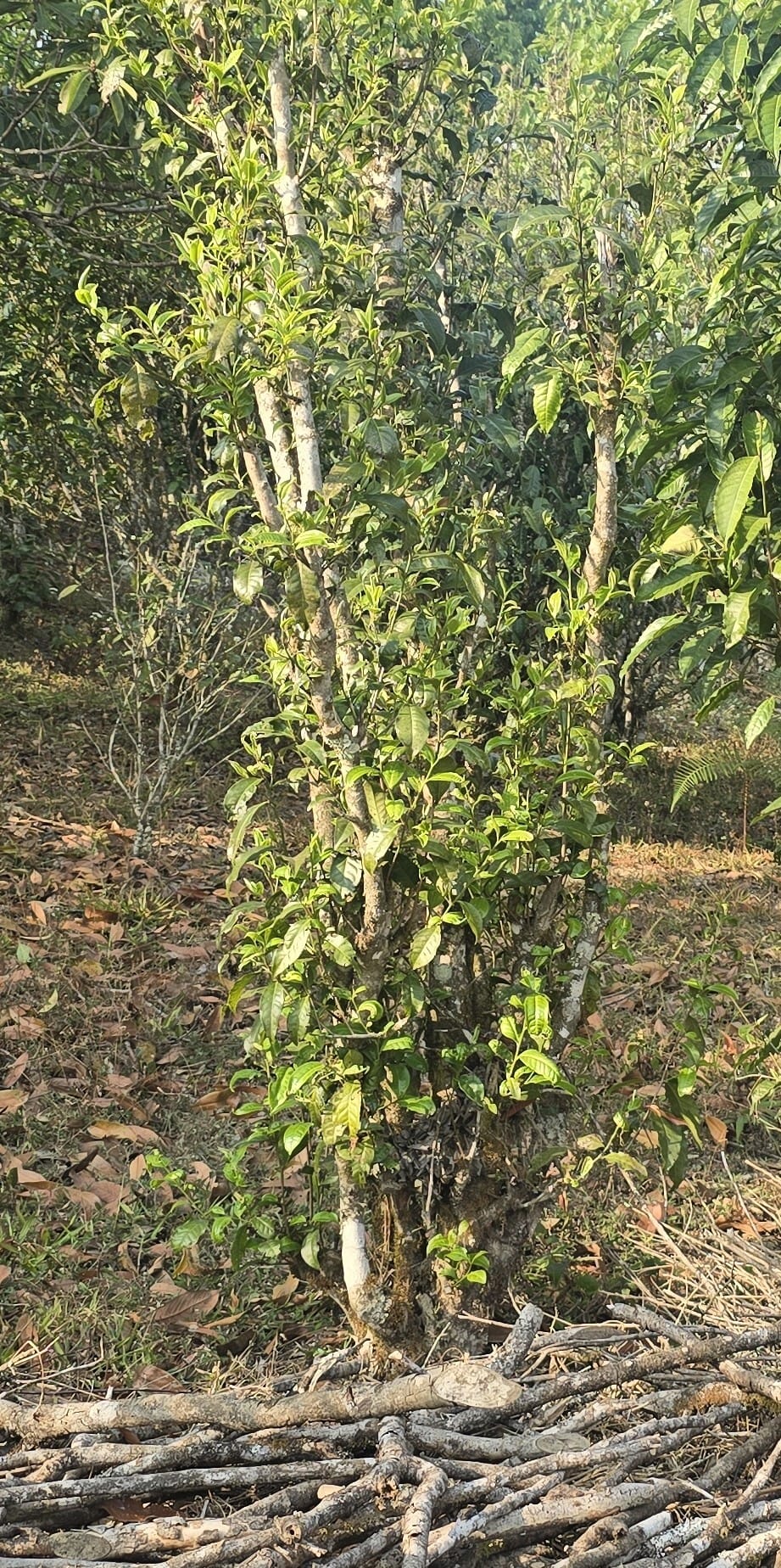
Watching weedwhackers moving through the gushu forest of Laobanzhang, pushing between the numbered trees responsible for record setting danzhu prices, I ask a tea-farmer friend visiting from another village what he thought of the LBZ farmers mowing the forest; he replied: “it’d be better if they didn’t use gasoline…”. His issue wasn’t with the weeding but the petrol fumes from the gas-powered weedwhackers. He explained that the weeds and undergrowth can compete with the tea for nutrients, and perhaps the mowed plants will help fertilize the soil if left in place.
If weeding was the limits of intervention in the gushu gardens, we could leave this topic as a matter of opinion – perhaps the prevalent species of weeds are more or less beneficial in some areas, or the soil particularly strong or weak, or the recent weather good or bad; as a farmer of knowledge, I would never venture to debate a farmer of the soil on the care of his crops, pitting my episteme against his techne… though if I were to play devil’s advocate (a role I’ve well practiced as a master debater[62], spilling the seed of my mind across many a forum) and engage in this argument, I would draw from the experience of the wine world, where new techniques of entretien du sol[63] have overtaken the interventionist methods of the modern period: many biodynamic wine makers (including prestige grandes dams of the wine world Domaine de la Romanée-Conti and Domaine Leroy) are now planting seasonal weeds as cover crops on previously bare soil between the vines, in a practice known as enherbement; adding weeds to the vineyard instead of removing them. In viticulture, this is usually paired with very shallow tillage to remove the cover crop during growing season, though other wineries now promote an established meadow-like environment within the vineyard. In general: those seeking quality versus yield are increasingly opting for low or no intervention agricultural practices, to a level previously unthinkable in recent history. Back in the gushu gardens, I for one have never seen a tea tree struggle to coexist with dense undergrowth… and in fact, the mix of dense undergrowth and high canopy cover is what incubates the prized gaogan trees many of us willingly pay a premium for; the jungle is Nietzschean and the tall trees are Überspecimen – that which does not kill them makes them taller. The ancient forest provides. The present gaogan gushu trees didn’t need tilling or fertilizer for the will to power through the canopy.
Which leads me to the question: what even is gushu tea? Used correctly, gushu as a label can be applied to the tea from any arbor-type[64] tree over 100 years old. The term is widely abused and often misunderstood, such that blended teas with only a tiny component of gushu material or mix pick “gushu garden” tea (the fairly standard practice of harvesting a garden without separating the gushu and qiaomu trees) are deceivingly labeled as “gushu”, without specifying range of ages or ratio of the blend. Beyond this more blatant abuse of a marketing term lies a less obvious and far more difficult layer of knowledge, attributing quality to the arboricultural treatment of the specific trees, harvested to make a tea: gushu trees may have been heavily pruned, previously pollarded, or recently coppiced; they may grow in tilled and fertilized soil; or the harvest may be second flush – any and all of these factors are invisible under the gushu marketing label, while having a larger effect on the flavor profile and quality of the soup than any large-number age claim.
What matters more: the age of the tree or the health of the environment? For me, over the last few years, it’s become much easier to say: while both play a role and older trees often bear a unique flavor of age, I argue that the best tea is a product of the environment, that a more “natural” environment less beset by interventions aimed at increasing yield produces better tea; that High Modernism in the gushu gardens has been an intergenerational failure damaging the quality of Yunnan’s tea, perhaps irreparably during our lifetimes; and that younger trees from no-intervention forest lands largely produce better tea than old gushu trees from high intervention gardens.
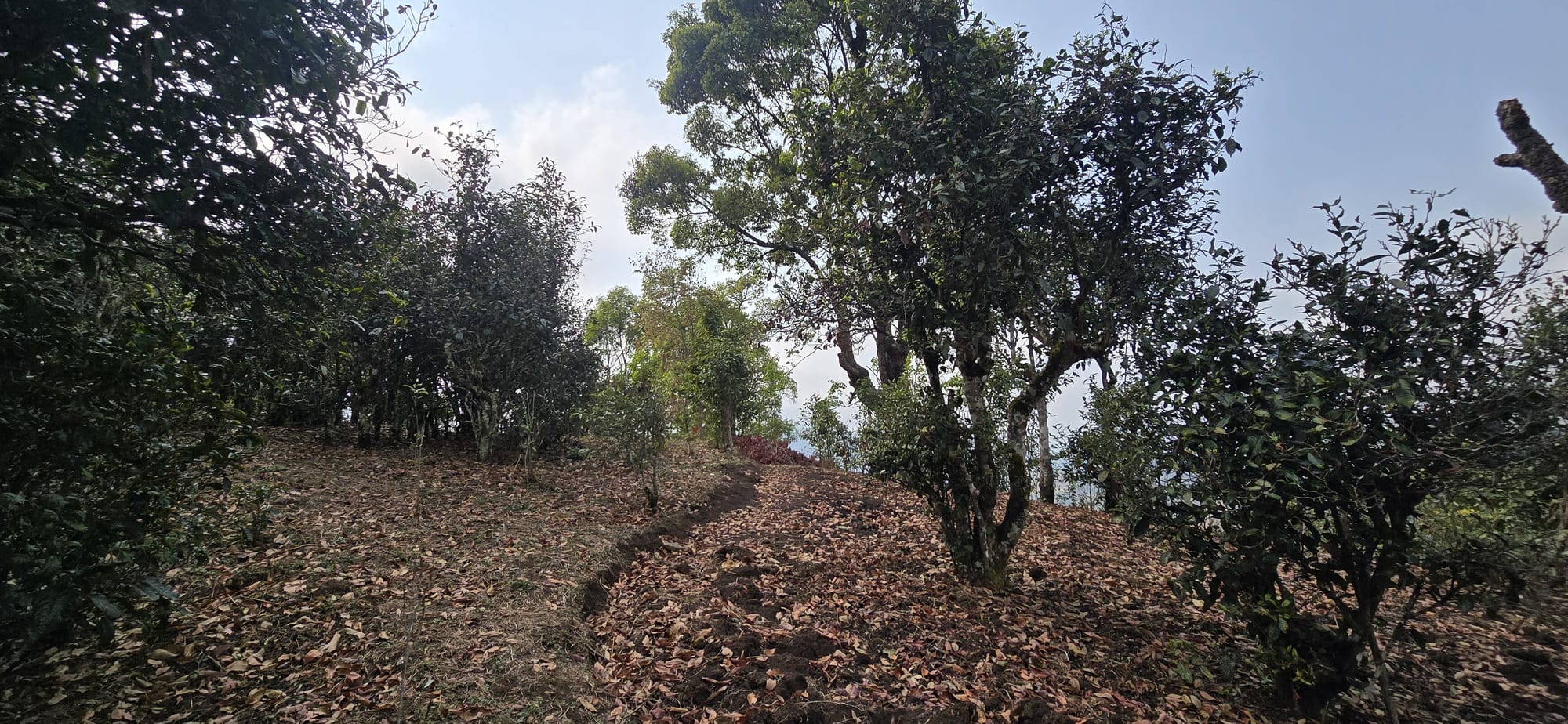
Old primary forests are largely self-sustaining environments[65], recycling nutrients within the ecosystem across the lifespans of numerous plant and animal species. Dead leaves, branches, and other organic matter shed from plants are left on top of the soil as the litter layer, which decomposes through the digestion of bacteria, fungi, and a dense community of detritivores (earthworms, termites, and other invertebrates); the decomposed plant and animal material is deposited into the humus layer, which captures organic carbon and filters nutrients into the topsoil. The nutrient rich humus fertilizes the topsoil, allowing trees and other plant life to flourish; from which they drop new leaves and branches onto the forest floor, starting the cycle anew[66].
In tropical environments, such as Xishuangbanna, the forest floor can look almost barren at the end of the dry season; the accelerated decomposition of organic matter in the warm and humid environment, paired with the seasonal monsoon rains leaching nutrients over geological timescales, leaves a humus layer mere millimeters thick[67]. Despite their nutrient-poor lateritic and acrisol-type soils, tropical jungle environments, including Xishuangbanna, are some of the most productive ecosystems on earth; the forest is lush because nearly all of the biosphere's nutrient capital is held in living biomass, and the ecosystem has evolved to recycle that capital with extraordinary efficiency. These adaptations include surface-level fungal beds, reaching into the litter layer above the soil, where the symbiotic tree-root-and-mycorrhizal-fungi relationship often bypasses humus formation entirely through the direct transfer of nutrients. Gushu tea trees have hyphal networks (small fungal filaments) extending laterally well beyond the rooting zone across the forest, connecting them to neighboring plants and to the litter layer[68]. Tea plants are highly mycorrhizal, forming arbuscular mycorrhizal associations (symbiotic relationships between plants and soil fungi) that actively trade nutrients and aid in phosphorus acquisition[69], while providing disease resistance and stress tolerance.
Out of all the high-intervention practices, two stand out as particularly damaging: tilling and fertilization, often paired together. The combination prevents undesired weed growth and promotes heavy tea sprouting, both of which are aimed at increasing yield; this often works in the short-run, while destroying the soil cycle across multiple mechanisms in the sooner-than-expected mid-run.
Healthy forest soil is composed and bound by macroaggregates: clumps of minerals glued with sticky microbial polysaccharides, fungal hyphae, and plant roots; the aggregates collectively help physically protect soil organics from oxygen and foreign microbes. Tilling shatters the aggregates and exposes the organic compounds to oxygen, causing aerobic decomposition and the loss of organic carbon. Tilling on slopes also increases erosion and can allow heavy rains to wash away the entire topsoil, permanently altering the ecosystem. A thin biologically active topsoil is necessary for forest health: leaf litter, humus, fungal hyphae, and small roots all help create an active biota and bound macroaggregates that migrate deeper into the soil over time[70].
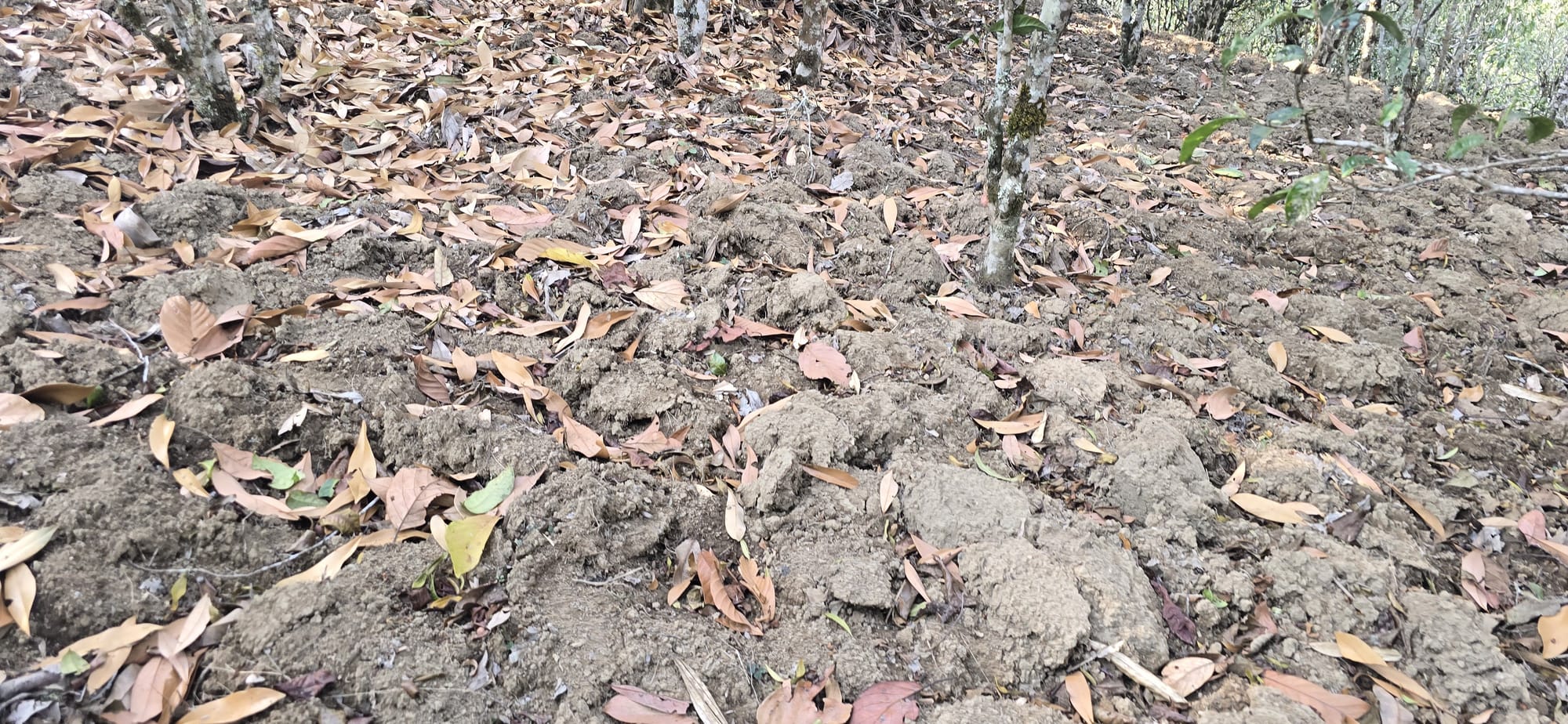
For the tea plants themselves, tilling can prove disastrous: their hyphae are fragile and severed by tilling blades; cutting the fungal symbiotes removes the self-sustaining organic-nitrogen and organic-phosphorus cycles, after which, fertilizer is required to sustain growth.
Fertilization causes soil acidification[71]. The famous red-soil of Xishuangbanna[72] is naturally acidic and the addition of ammonium-based nitrogen fertilizers drives further nitrification derived acidification, far beyond the optimal point for tea trees. Modernized tea plantations across Xishuangbanna already face issues from ionic aluminum (Al3+) becoming soluble in the increasingly acidic soil (measured at below 4.5pH), which damages a tea plants’ roots and prevents mineral uptake[73]. Worse still, high phosphorus fertilizers downregulate symbiotic activity between plant and soil fungal colonies[74], which further disrupts the self-preserving soil cycle; even a single round of fertilization can deplete soil humus reserves by priming nitrogen hungry bacteria with easy fuel to colonize the previously protected macroaggregates, permanently shifting the soil ecology from fungal-dominant to bacterial-dominant[75].
Fertilized tea trees of any age grow a larger mass of thin and tender vegetation, where each leaf and bud contains less concentration of the compounds that make tea taste good. Fertilized trees produce worse quality per unit weight of tea. I and a few very special readers of this ongoing diatribe have had the spiritual experience of putting a single leaf of great gushu into a bowl, captivated by its intensity, complexity, and feeling. That is not an experience one can achieve with fertilized tea.
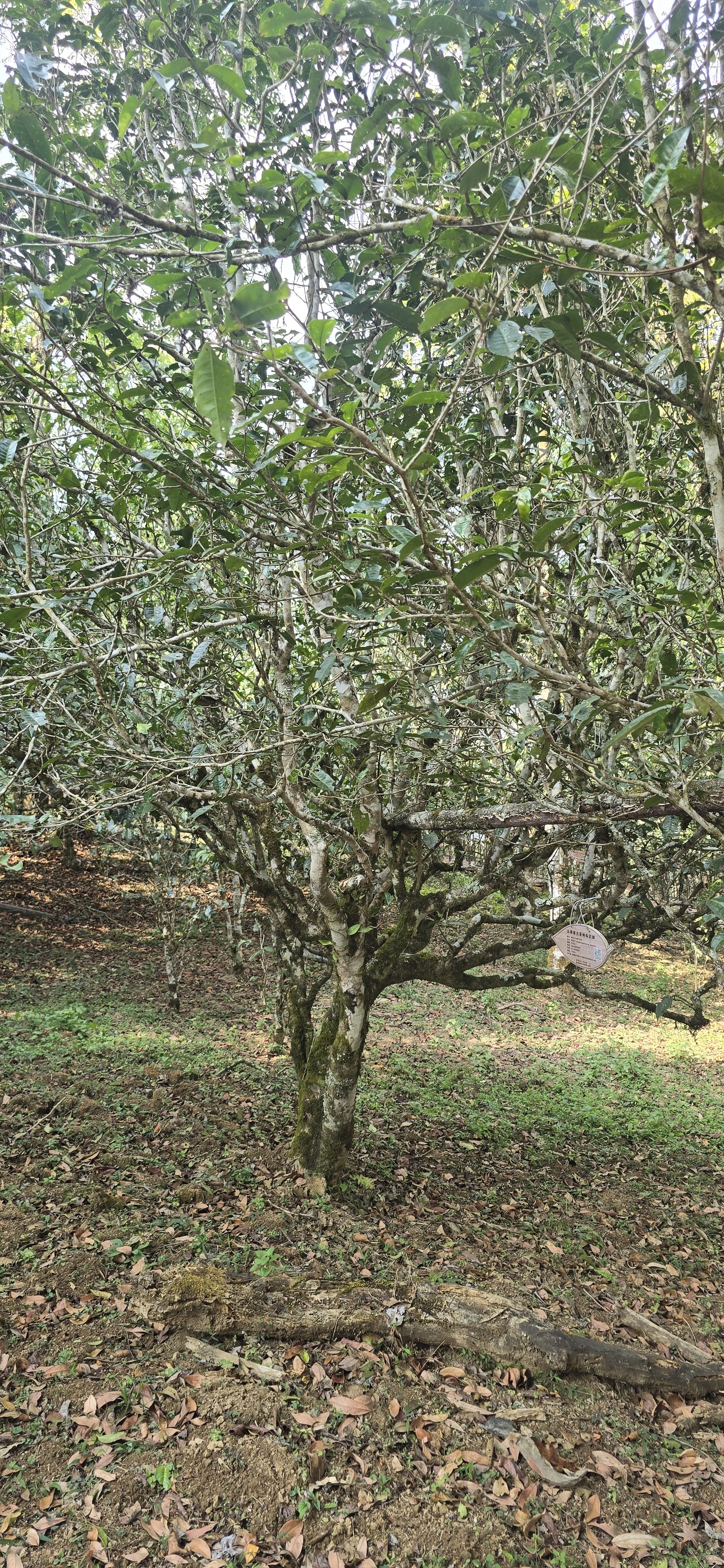
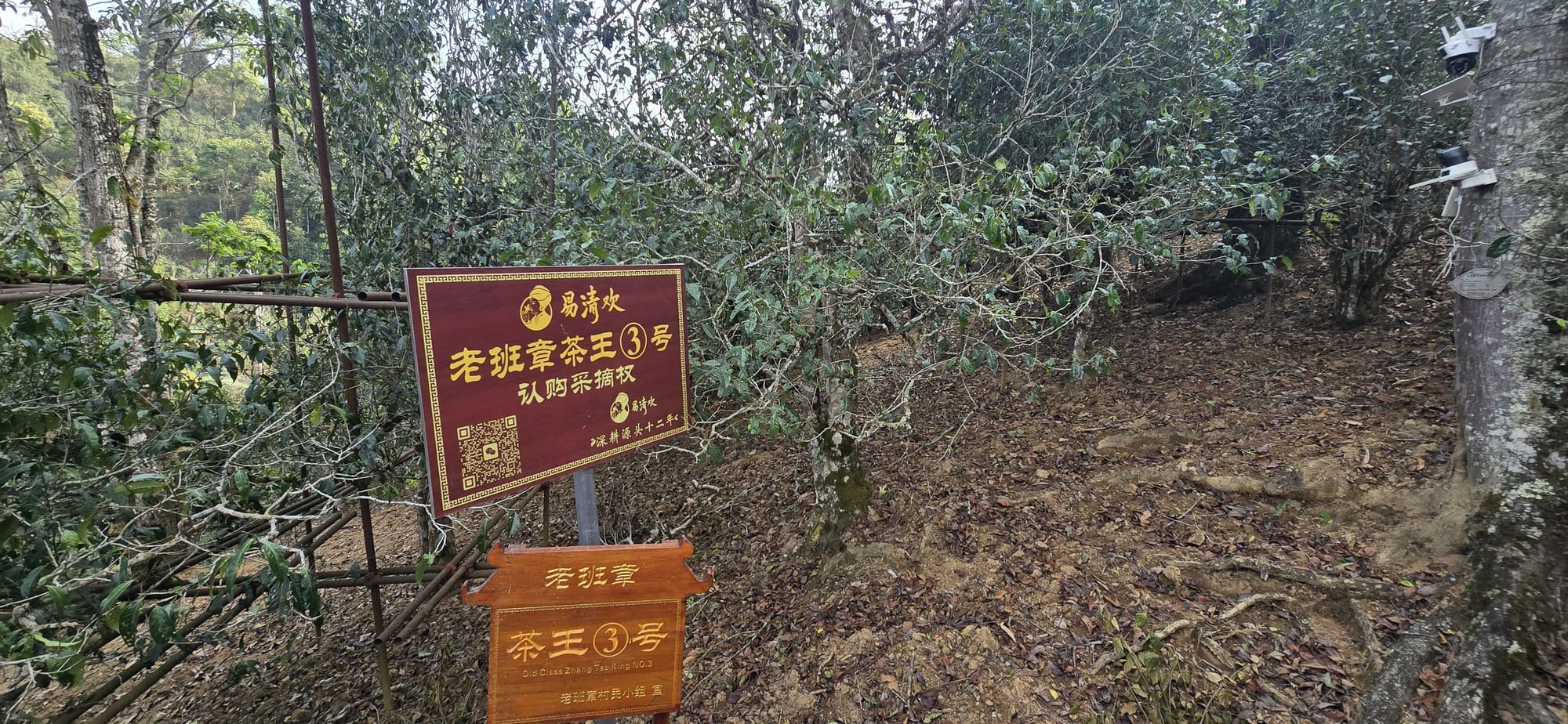
Neighboring gardens in Laobanzhang: on the left, the farmers apply heavy weeding; on the right the soil is tilled and fertilized.
I’ve thought hard about exceptions to this rather dichotomous ideal and haven’t managed to find any good reasons to till or fertilize undamaged gushu forest lands; farmers will occasionally claim soil compaction, from pickers walking the trails or tourists tramping through the tea forest, necessitates tilling, though I find no merit in this argument. Perhaps a rare exception could be made for fighting off invasive ingrowth, such as bamboo encroaching on the tea garden, though in these limited cases the cure may be worse than the disease.
On the other hand, I am not against intervention in extremis; neglect-induced decline of previously tended trees is real, and is a good argument for the continuation of previous endemic-ethno-eco-forest management practices[76], including the pruning of deadwood and weak growth, limited picking windows and levels, the addition of external support for oversized trees in danger of uprooting, and the removal of invasive or damaging plants such as mistletoe (桑寄生), dodder (无根藤), and kudzu vine (葛根). Though again, these interventions are minimal and tied to specific outcomes unrelated to increasing yield, and again ad nauseam, despite some claims to the contrary, there is no historical evidence of Dai, Hani, or Bulang tilling or fertilizing arbor tea trees in the forest. The advent and application of High Modernist forest management techniques have been targeted exclusively at increasing short term yield at the cost of long-term quality and environmental health. Perhaps additional intervention will be necessary as the up-mountain climate warms and lower-elevation pests infiltrate the forest as a consequence of climate change.
The natural wine movement has struggled with the same question, with much of the ideological debate moving from production practices (yeast, sulfur, filtering, pigeage, etc) to the field (weeding, fertilization, cover vegetation, and tillage); over time, variations in production methods (including small doses of SO2) have become more accepted while deviations from organic purity in the field have become less accepted. This seems to be the direction of the high-end pu’er market (with even large tea plantations going “shengtai”) and appeals to me as the right balance: allowing creativity and variation on the human-led production side while maintaining the natural forest environment on the agricultural side. The old vines of Rioja producing low-yield high-concentration Garnacha, for example, are never fertilized – doing so would increase yield and reduce the flavor concentration for which they’re prized.
Tea in China generally and Yunnan specifically seems to be moving in the same direction, driven by consumer demand for organic and ecological products, market incentives for premiumization, and new government regulations in response to various incidents. In 2019 CE, gushu trees were protected under the 古茶树保护管理 (“protection and management of ancient tea trees”) and 古茶树管护 (“care-management of ancient tea trees”) sets of policies at the provincial level; enforcement varies at the village level and the damage is ongoing as fluctuations in the pu’er market drive cultivators to prioritize economic incentives over long-term health of the tea trees. Certain municipalities implemented additional voluntary protection standards for gushu tea trees on private land, following the lead of the provincial government and other initiatives for "Green prevention and control" (绿色防控), a standard Chinese agricultural-policy for integrated, low-intervention pest management emphasizing ecological methods over synthetic pesticides. The 2022 Pu’er City Municipal Standard DB5308/T 54–2022, for example, is based on the collaborative work of the Pu'er Quality and Technical Supervision Comprehensive Testing Center (which houses the National Pu'er Tea Product Quality Inspection and Testing Center), together with the Pu'er Tea Research Institute, the Tea Research Institute of the Chinese Academy of Agricultural Sciences, and the Pu'er Plant Protection and Quarantine Station, as well as comments from pu’er producing companies; it recommends a strategic ladder of intervention, starting with low intervention solutions to weeds, pests, and soil issues before allowing the application of pesticides, fertilizers, or tilling:
以确保茶叶生产, 茶叶质量安全和茶园生态安全为目标, 以减少化学农药使用为目的, 优先采取生态控制, 生物防治和物理防治与科学用药等环境友好型技术措施控制茶树病虫草危害的行为.
With the goal of ensuring tea production safety, tea quality safety, and tea garden ecological safety, and with the aim of reducing chemical pesticide use: ecological control, biological control, physical control, and the scientific application of pesticides are to be prioritized – in that order – as environmentally friendly technical measures for controlling pest, disease, and weed damage to tea trees.
- Pu'er City Agriculture and Rural Affairs Bureau (普洱市农业农村局). Green Prevention and Control Technical Regulations for Major Diseases, Pests, and Weeds in Pu'er Tea Gardens (普洱市茶园主要病虫草害绿色防控技术规程]): Pu'er Municipal Standard DB5308/T 54–2022.
The 2022 Yunnan Provincial Ancient Tea Tree Protection Ordinance (云南省古茶树保护条例) is the newest environmental protection law and a step in the right direction for the long-term health of the forest and gushu pu’er trees; like most environmental regulation, its likely too little too late by design – drafted in response to the current issues facing many of the gardens and forest lands damaged by high-modernist practices, market-forces, nearby development, and short-term greed. Still… I would rather have the regulation than not, and the Chinese central and prefectural government has shown the ability to move quickly and decisively when incentives are aligned. Certain villages and areas have likewise shown more willingness to enforce self-imposed ecological practices than others, as some farmers and village leaders have recognized the need for long-term environmental protection lest they kill the old goose that lays the golden green leaves.
So again - what even is gushu?
Soil intervention weakens the very ecology that gave rise to the unique attributes of gushu tea: if the claim that gushu is good because you’re tasting the forest environment in which it grew for centuries is true, then disrupting that forest environment and replacing the natural self-sustaining soil cycle with tilling and inorganic fertilizer must be destructive to quality. The soil, and the process that gave birth to that specific soil in which the tea is growing, is the terroir. Once the organic aggregates are broken and oxidized, the organic carbon lost, the hyphal networks severed, and the soil acidified – then the process cannot be reversed within the timescale of a human lifespan; the gushu trees in that environment are no longer drawing on the resources that made them good gushu in the first place.
The age of the tree is probably just a made-up number: when we look for gushu and focus on the age of the tree above the health of the forest environment from which it came, we’re buying into a merchant myth designed to part a fool from their money. I have played that fool – I love my 500-year-old ancient tree tea-king from a “secret area” with “hints of Wangong” as much as the next guy; I feel lust and fear and desire when there’s “only 6 cakes available” in the pre-order; I earnestly want to believe that the $900 per bing price tag is merited by the big round age number that stands in for everything supposedly good about this hypothetical tea and substitutes for real knowledge about its processing and environment.
[1] 江湖; a mystic world operating under its own rules and systems. This allusion is cribbed from Zhang Jinghong’s excellent book Puer tea: ancient caravans and urban chic (University of Washington Press, 2013), in which she describes the available vendor and internet knowledge of pu’er as creating a Jianghu, a fantastical landscape that must be traversed to complete the noble quest.
[2] The concept of High Modernism was introduced by James C. Scott, Seeing like a State: How Certain Schemes to Improve the Human Condition Have Failed (New Haven: Yale University Press, 1998).
[3] This is termed flattening by Scott.
[4] Xishuangbanna is the Chinese transliteration of the original Dai language name “Sipsongpanna”.
[5] The Dai people still compose the majority of the population of Xishuangbanna today, which is officially called “Xishuangbanna Dai Autonomous Prefecture”.
[6] The Zhaopianling and various Zhaomeng were all, from the Yuan dynasty onward, Tusis in the Chinese Imperial system; the Zhaopianling and his dominion over the Zhaomeng was also recognized by the King of Burma which carried weight with the Buddhist clergy and religious Dai population.
[7] Precariously placed between British Burma and French Laos, Xishuangbanna survived as a proto-buffer-state; internally, China failed to replace the Tusi system despite multiple attempts.
[8] The Bulang mountain range and the Bulang ethnicity (布朗) share a name; the ethnic group is occasionally rendered as Blang or Phlang in English to represent the non-Chinese origin and local pronunciation of the name, though I have chosen to render all words using standard pinyin here.
[9] Fan Chuo 樊綽, Manshu jiaozhu 蠻書校注, annot. Xiang Da 向達 (Beijing: Zhonghua shuju, 1962), juan 7.
[10] 茶出銀生城界諸山, 散收, 無採造法. 蒙舍蠻以椒, 薑, 桂和烹而飲之. "Tea grows on the mountains within the borders of Yinsheng City (銀生城). It is gathered without order, and there is no method for its picking or processing. The Mengshe Man (蒙舍蠻) boil it together with pepper, ginger, and guì (桂, Cinnamomum cassia), and drink it."
[11] Before the Qing, China favored tea from Sichuan for trade with Tibet, where it was boiled with soured yak’s milk and rancid yak butter. An acquired taste.
[12] Some of the larger Yiwu tea merchant families maintained sales offices in Hong Kong, Thailand, and Vietnam.
[13] Just to confuse everyone: the Chinese government renamed the prefecture of Simao to Pu’er and renamed Pu’er town (which is in Simao) to Ning’er, and left the other town named Simao with its original name.
[14] There is occasional confusion when discussing Yiwu as it may refer to a region (the entire Six Famous Tea Mountains), a single mountain (Mansa, now called “Yiwushan”), or a pre-modern polity (the lower-rank Tusi of Yiwu, who controlled only Mansa Mountain and its surroundings; while 5 of the 6 famous tea mountains were under the Yibang Tusi’s domain). I attempt to specify when using Yiwu as the shorthand for the entire region of the 6 famous tea mountains in this text.
[15] This was not the original intent or desire of the Chinese government, who failed to quell the uprising on their own; the recognition of Cao Danzhai as Tusi was a realpolitik outcome of a revolt instigated by the attempted replacement of the entire Tusi system with imperial rotating bureaucrats.
[16] “其餘小山甚多,而以蠻松產者為上” (“There are many other small mountains; among them, the [tea] produced at Mansong was considered superior”). Zheng Shaoqian 鄭紹謙, comp., and Li Xiling 李熙齡, rev. comp.,普洱府志 (Gazetteer of Pu'er Prefecture), 20 juan, woodblock ed. (Xianfeng 1 [1851]; comp. completed Daoguang 30 (1850 CE)), juan 8, "Wuchan" 物產, s.v. "Cha" 茶, National Library of China, shelfmark 地350.125/136.
[17] “獨有普洱號剛堅, 清標未足誇雀舌… 寒香沃心俗慮蠲” (“Pu’er alone merits the designation ‘firm and robust’; even ‘pure and refined’ does not fully praise its sparrow-tongue tips … its cool fragrance bathes the heart and dispels worldly concerns”). Hongli 弘曆, 烹雪用前韻 (“Boiling Snow, Using the Previous Rhyme”), in御製樂善堂全集定本, juan 19, Qianlong-period Wenyuan Pavilion Siku quanshu manuscript, National Palace Museum, accession nos. 故庫030857–030868. Hongli is the Qianlong emperors given name, used before ascension to the throne; this was written while he was crown prince.
[18] “賞庶吉士人等清茶, 用普洱茶一斤四兩四錢” (“Tea was bestowed or served to the shujishi and others, using one jin, four liang, and four qian of Pu’er tea”) and “賞王子大臣翰林等普洱茶三瓶, 花茶五瓶” (“Three caddies of Pu’er tea and five bottles of flower tea were bestowed on princes, high officials, Hanlin scholars, and others”). 宮中雜件 (Miscellaneous Palace Papers), juan 4, bao 2088, “Wupin lei: Shipin: Chaye” 物品類·食品·茶葉, entry dated Qianlong 53, third month, twenty-fifth day (1788), Palace Museum Archives; transcribed in Wan Xiufeng 萬秀鋒, 清宮普洱貢茶述論 (“A Discussion of Pu’er Tribute Tea in the Qing Palace”), 71, Palace Museum digital publication and Qing court Dragon Boat Festival gift register, Jiaqing 25 (1820 CE], transcribed in Zhou Qian 周乾, 明清皇帝端午節的賞賜活動 (“Dragon Boat Festival Bestowals by Ming and Qing Emperors”), Zijincheng 紫禁城, no. 6 (2017): 99.
[19] Similar to studies of various folios of Shakespeare across a range of disciplines, often aimed at discerning original intent from later edits, the epic Dream of the Red Chamber has its very own branch of interdisciplinary study termed “Redology” (红学).
[20] Unlike other teas, pu’er is thought to be warm in traditional Chinese medicine; other physiological effects are likewise notably different, possibly rooted in its unique genetic lineage. This may have been of some interest to early drinkers and a potential source of early popularity, amongst the few literati in Beijing consuming pu’er tea.
[21] The sixth solar term of the Chinese calendar coinciding with the transition from spring to summer between April 20th and May 5th.
[22] This is a slight simplification of three separate policy changes: the monopoly was established in 1729 CE, such that Han merchants could only purchase tea from the official down-mountain trading center in Simao; this didn’t really work and was reverted to a licensing regime, after only 6 years, in 1735 CE. The policy was fully abandoned in the late-Qianlong era, when Han settlements in the mountain were officially sanctioned.
[23] Kazutaka Nishikawa 西川和孝, 清末民国期の雲南省普洱における漢人移民と茶山開発について―漢人の技術移転と市場開拓の視点から― (Han Chinese Immigrants and the Opening of Pu’er Tea Gardens in Yunnan Province during the Late Qing and Republican Periods: Technology Transfer and the Tapping of New Markets), Tōyō Gakuhō 東洋学報 93, no. 2 (September 2011): 145–171. Nishikawa places the organized recruitment of Shiping Han migrants at the end of the Qianlong era (1736 – 1795 CE), later than other sources.
[24] The modern conversion rate is: 1 acre = ~6 mu; 1 hectare = ~15 mu; so 30,000 mu = ~4,942 acres = ~2,000 hectares; the exact conversion in Qing dynasty Yunnan likely varied marginally.
[25] Zhan Yingpei 詹英佩, 中国普洱茶古六大茶山 (“China’s Pu’er Tea: The Ancient Six Great Tea Mountains”), Kunming: 云南美术出版社, 2006. Zhan doesn’t show her work in arriving at this ~30,000 mu number, though I find the estimate credible as an approximate order of magnitude; this level of agricultural expansion matches approximate pu’er yield from merchant accounts and retrospective peak-planting estimates for individual mountains.
[26] Tan Cui 檀萃, 滇海虞衡志 (Treatise on the Natural Resources of Dian (Yunnan)), 1799 CE, juan 11. This is a stylistic exaggeration, though the feeling is indicative of the surprising growth of the Yiwu region.
[27] During the RoC and eventual People’s Republic of China, the Tusi’s swore alliance only to the Chinese government.
[28] Burma was under British colonial rule from 1824 to 1948 CE; the British built modern infrastructure and offered safe passage for trade, capturing the merchant-routes from Menghai. The Irrawaddy River supported steamship transport as early as 1894 CE, further decreasing time and transport costs. Despite the circuitous route and length, the Southern trade was profitable.
[29] Hill, Ann Maxwell. “Chinese Dominance of the Xishuangbanna Tea Trade: An Interregional Perspective.” Modern China 15, no. 3 (1989): 321–45.
[30] Also known as the Dai-lue or just the Lue tribe.
[31] This is argued by Zhou Chonglin (周重林), “古茶园:呈现自然与人类早期的生活秘密” (“Ancient Tea Gardens: Revealing the Secrets of Nature and Early Human Life”), 文汇报, March 19, 2020, sec. 苦甜古茶园; while not peer reviewed, I independently came to the same conclusion after the TTRT2026 fieldwork. The mechanism for plant selection in forest environments by human populations has been studied in the field of ethnobotany; Pei et. al. found the composition of forest tea gardens in Bulang were not naturally arising populations, but cultivated plant communities whose selection has been altered through long-term human intervention. Pei Shengji (裴盛基), Gou Yi (苟祎), Geng Yanfei (耿彦飞), and Wang Yuhua (王雨华), ”民族植物学视角下的森林茶园” (“Forest-Tea Garden from the Perspective of Ethnobotany”), 中国茶叶 44, no. 12 (2022): 66–72.
[32] Ming Chenghua 12; this date is attested to by the Banzhang village chronicle and oral tradition of the Hani; research on the veracity of the date is supported by 刘作燕 (Liu Zuoyan), 张林 (Zhang Lin), and 杨玉琼 (Yang Yuqiong), “乡村振兴过程中传统文化的传承与保护研究” (Research on the transmission and protection of traditional culture in the process of rural revitalization”), 云南省城乡规划设计研究院 (Yunnan Provincial Institute of Urban and Rural Planning), September 6, 2023.
[33] One such mention is in 章履成, 纂修, 《元江府志》(”Gazetteer of Yuanjiang Prefecture”), 卷1, “山川”, s.v. “莽支山” (康熙五十三年 [1714] 修;抄本,据康熙五十三年修本传抄), University of Washington Libraries, call no. DS796.Y7363 Y8.
[34] Nannuoshan is distinct here as it was often treated closer to Yiwu tea, despite its location outside the Six Famous Tea mountains.
[35] 此茶揉製時, 不能入水, 否則揉製完畢後, 易起黑霉, 有損失茶葉品質. 黃晃,〈雲南普思沿邊茶業概況〉,附錄第十章,收入《中國熱帶作物》第1編(商務印書館,1940年11月),175–78。
[36] “‘High-grade’ material had to be moistened one day in advance with an appropriate quantity of water, a procedure called ‘moistening the tea’ (chaocha 潮茶).… After it had been formed into a mass, because considerable moisture remained, it fermented once more.… Several days later, a kind of yellow mold developed inside and out.” 李拂一,佛海茶業概況,”教育與科學” 第5期 (1939年3月25日): 153.
[37] The 40-day figure is from Tan Fanzhi (1944 CE); earlier sources vary on shorter time-frames though it seems longer is better for equilibration; this seems similar to contemporary shou pu’er drying times.
[38] Likely a colonization of Eurotium cristatum (Now classified as Aspergillus cristatus in more modern academic texts ), a golden colored fungus often known to tea drinkers as “golden flowers”. “Pine Pollen Mold” (松花霉) mold from Huang, Yellow mold from Li.
[39] 云南省茶叶进出口公司编. ”云南省茶叶进出口公司志 (1938–1990)”. 昆明: 云南人民出版社, 1993 and Shuenn-Der Yu, “Materiality, Stimulants and the Puer Tea Fad,” Journal of Chinese Dietary Culture 6, no. 1 (2010): 107–42, esp. 129–31, doi:10.30152/JCDC.201001.0004.
[40] 云南省思普企业局南糯山茶叶实验场.
[41] A large portion of the traders running the overland caravans were ethnic-Chinese Muslims, a loosely defined grouping of people collectively called “Hui”. Tea was taken from the Xishuangbanna trade centers of Pu’er and Menghai to Tibet, Guangzhou, Beijing, and Southeast Asia predominantly by merchants of Han or Hui ethnicity, with exceedingly few caravans led by Bai, Naxi, or Tibetan peoples trading to their own homeland. In any case, the Hui were prominent enough in the region to have a mosque and approximately 100 households in Mangzhi (莽枝) and a satellite mosque in Wangong (弯弓寨). 肖坤冰. 从“高地”到“低地”——从“佐米亚”概念看清代云南边境的普洱茶贸易与族群互动 (From “Highland” to “Lowland”: Pu’er Tea Trade and Ethnic Interaction on the Yunnan Frontier in the Qing).民俗研究, no. 2 (2018): 57–66.
[42] Though there is a distinct if rare pre-modern tea tree shaping practice of “rattan-branch tea” (藤条茶) in which new growth is stripped along the entire branch preserving only a few leaves around the apical meristem; repeated over time, this process directs vegetative outgrowth towards the tip, producing long-and-slender elongated branches; long durations of this practice form a tea plant with many wispy “rattan like” branches which hang down like willow vines which gives the method its name. The tea produced from these trees is highly regarded, though I have not yet had the pleasure of knowingly tasting tea cultivated with this method.
[43] Ethnohistorian Zhan Yingpei (詹英佩) writes that the trees so handled resumed their upward growth after the removal of the restraints: “once the ties were released, the branches of the ancient tea trees sprang back and extended very high”; the meaning here is partially unclear – bonsais, espaliers, and other shaped trees often hold the memory of their restraint even after removal, even while new growth returns to a natural pattern; Zhan may be referring to younger trees that had not been long trained, or to the trees after a few seasons, where the new growth changes the shape of the tree.
[44] 阮福, 普洱茶记, 1825年。引思茅志稿.
[45] From the early 1970s to late 1980s, the Yunnan government was under orders from the central government to better integrate the various ethnic minorities into the socialist collective agricultural system; this policy is partially a result of that High Modernist order from the central government.
[46] Zhan Yingpei (詹英佩), 《普洱茶原产地西双版纳》 (“Xishuangbanna, place of origin of Pu'er tea”), 云南出版集团公司, 2007. This is based on ethnographic and oral history, though again I find her work to be credible and well-aligned with my own research findings.
[47] The commencement of the Transform the Old and Actively Develop the New Tea Garden (改造老茶园, 积极发展新茶园) policy promulgated by Yunann’s provincial government.
[48] “20世纪80年代在勐阿南朗河村进行低产茶园改造,其中一亩茶叶产量达260.65千克,而改造前每亩平均单产只有21.1千克…到2000年时实际已完成100634亩”; The ten-fold increase is for the best performing lot of about ~10 mu, not for the entire village. Average increase is more than 3x, up to ~70 kg per mu. 勐海县人民政府 (Menghai County People's Government), 《勐海县茶叶技术服务中心科技志》 (“Science-and-technology record of the Menghai County Tea Technical Service Center”, compiled16 March 2009.
[49] Various published accounts disagree by a year or so on establishment or planting dates; a commercial article dates the establishment of both Bada and Bulangshan plantations to June 1988, while Xinhua dates Bulang alone to 1988; Dayi companies’ official history dates completion of both bases to 1989. Citing only Xinhua and Dayi: 荆克, 程丹, and 李晏, “‘三茶’统筹发展的‘大益’样板” (“The Dayi model of coordinated development of tea culture, tea industry, and tea technology”, 新华网, October 2, 2024 & 大益集团, “82载老字号续写新章:勐海茶厂凝心聚力展望百年” (“An eighty-two-year-old brand writes a new chapter: Menghai Tea Factory looks toward its centenary”, November 2, 2022.
[50] 郭红军, “权威发布:云南省茶业统计数据 (1950–2020)” (“Authoritative release: Yunnan tea-industry statistics, 1950–2020”), 云南省茶业协会, reposted by 爱普茶网, May 10, 2021; table 1.
[51] Nicholas K. Menzies, “Ancient Forest Tea: How Globalization Turned Backward Minorities into Green Marketing Innovators,” in The Social Lives of Forests: Past, Present, and Future of Woodland Resurgence, ed. Susanna B. Hecht, Kathleen D. Morrison, and Christine Padoch (Chicago: University of Chicago Press, 2014), 241, 243, 246–47, doi:10.7208/chicago/9780226024134.003.0021 and Po-Yi Hung, “Tea Forest in the Making: Tea Production and the Ambiguity of Modernity on China’s Southwest Frontier,” Geoforum 47 (2013): 181–82, doi:10.1016/j.geoforum.2013.01.007.
[52] Tian Yiping (田易萍), Xu Pizhong (徐丕忠), and Zhu Xingzheng (朱兴正),国家级茶树良种云抗10号在云南省的应用及推广 (“Application and promotion of the national tea cultivar Yunkang 10 in Yunnan Province”),现代农业科技 (Modern Agricultural Science and Technology), no. 24 (2011): 118–19; and Ji Pengzhang (季鹏章), Jiang Huibing (蒋会兵), Huang Xingqi (黄兴奇), Zhang Jun (张俊), Liang Mingzhi (梁名志), and Wang Pingsheng (王平盛), 古茶园、台地茶园遗传多样性的AFLP分析 (“Genetic diversity of ancient tea gardens and tableland tea gardens from Yunnan Province as revealed by AFLP markers”),遗传 (Hereditas) 31, no. 1 (2009): 101–8, doi:10.3724/SP.J.1005.2009.00101.
[53] The story is a touch more involved than a single direct trip to Yiwu; twenty tea experts from Taiwan attended the “Third International Tea Culture Symposium” held in Kunming in August 1994; there they met Zhou Bingliang, former director of Menghai Tea Factory, who confirmed that their sample of Tongqing Hao was made with leaf-material sourced from the “Six Famous Tea Mountains” (which they already assumed based on the cake’s neifei). On receiving this confirmation, the Taiwanese delegation made an impromptu post-conference pilgrimage to Yiwu, meeting with government officials and taking notes on the oral history of earlier tea production. Some of the group returned the following year in 1995 to commission sheng pu’er tea. Personal trip reports were published by various attendees; the generally cited version in China was written by Yiwu local Zhang Yi’s (张毅) who was assigned to host and brief a Taiwanese delegation by the local government. Zhang Yi (张毅), 传承传统普洱茶制作工艺旧事 (“Old matters in transmitting traditional Pu'er production technique”), 西双版纳报, publication date unknown. Also note that the earlier techniques of Sheng processing were not entirely lost; there is evidence of small-batch stone-pressed dashu production as far back as 1984 by Gao Dingguang.
[54] Ibid; he writes of the price increase in his article covering the Taiwanese visit. Gushu wasn’t yet an independent category, so this pricing is for “dashu” which was any tea not grown in a plantation.
[55] This is spring peak price; the crash occurs this autumn, accelerating through 2008. Jinghong Zhang, 普洱茶的流动与流变 (“The flow and transformation of Pu'er tea”), lecture transcript, September 26, 2020, Guangzhou.
[56] Tea generated a lot of hard currency in foreign exchange: “In the 1980s one ton of Chinese tea exports could on average be exchanged for 10 tons of steel, 20 tons of grain, 22 cubic meters of timber, or nearly 2 tons of copper. Subsequently, the Chinese use the term "green gold" (lusejinzi) to denote the importance of the tea industry to their economy” So, Alvin Y. Review of Green Gold: The Political Economy of China's Post-1949 Tea Industry. China Review International 2, no. 1 (1995): 102-103.
[57] A 2004 survey by the Yunnan Forestry Department found Menghai had only 48,516 mu of ancient tea gardens, concentrated mainly in Gelanghe, Bulangshan, Xiding, and Mengsong.
[58] Jinghong Zhang, Puer Tea: Ancient Caravans and Urban Chic (University of Washington Press, 2014), pg 106 - 142.
[59] One study lists agilawood, houpu, camphortree, white bouhinia, and downy cherry as the government supported selection. Hung, Po-Yi. "Tea forest in the making: Tea production and the ambiguity of modernity on China’s southwest frontier." Geoforum 47 (2013): 178-188.
[60] Euphemistic IMO.
[61] “茶树台刈”. Zhihui Sannong, China Agricultural Press.
[62] parliamentary not policy, you fast-talking monsters.
[63] French wine term for strategies combining tillage or other soil-working, cover vegetation, and chemical or mechanical weeding.
[64] The term “gushu” is not standardized and there is occasional usage that varies from my own working definition; suffice to say, someone calling shrub type tea trees (the type found in plantations) as gushu is either being purposely provocative or purposely misleading. The Yunnan provincial rules defines gushu as any arbor-type Camellia plant that is either at least 100 years old or has a trunk diameter greater than 15cm measured more than 10cm from the ground….
[65] For fellow pedants: I am not arguing here that old-growth forests are closed-loop self-sustaining; the natural world is self-contiguous, and mineral weathering, atmospheric deposition, and other natural-but-external cycles obviously play a role in adding necessary inputs to healthy forest environments.
[66] This whole section draws from Peter M. Attiwill and Mark A. Adams, “Nutrient Cycling in Forests,” New Phytologist 124, no. 4 (1993): 561–82, DOI: 10.1111/j.1469-8137.1993.tb03847.x and Cindy E. Prescott and Lars Vesterdal, “Decomposition and Transformations along the Continuum from Litter to Soil Organic Matter in Forest Soils,” Forest Ecology and Management 498 (2021): 119522, DOI: 10.1016/j.foreco.2021.119522.
[67] “Litterfall Production, Decomposition and Nutrient Use Efficiency Varies with Tropical Forest Types in Xishuangbanna, SW China: A 10-Year Study,” Plant and Soil 335, nos. 1–2 (2010): 271–88, esp. 275–77 and 283, doi:10.1007/s11104-010-0414-2.
[68] Zhang et al., "Unraveling the Interaction between Arbuscular Mycorrhizal Fungi and Camellia Plants," Horticulturae 7, no. 9 (2021): 322.
[69] Herrera et al., "Direct Phosphorus Transfer from Leaf Litter to Roots," Naturwissenschaften 65 (1978): 208.
[70] This whole paragraph cites Six, Bossuyt, Degryze, and Denef, "A History of Research on the Link between (Micro)aggregates, Soil Biota, and Soil Organic Matter Dynamics," Soil and Tillage Research 79 (2004): 7–31 and James J. Hoorman, João Carlos de Moraes Sá, and Randall Reeder, “The Biology of Soil Compaction,” Agriculture and Natural Resources Fact Sheet SAG-10-09/AEX-543-09 (Columbus: Ohio State University Extension, 2009), 2–3, 6–7. For erosion estimates, see Montgomery, "Soil Erosion and Agricultural Sustainability," PNAS 104, no. 33 (2007): 13268–72.
[71] Yan, Peng, et al. "Synthetic Nitrogen Fertilizers Alter the Soil Chemistry, Production and Quality of Tea. A Meta-Analysis." Agronomy for Sustainable Development 38 (2018): 10.
[72] While red soil is the most common and generally prized soil for pu’er tea, Xishuangbanna also has black and yellow soil gushu gardens which produce great tea, in my opinion.
[73] 52% of measured tea gardens have a soil pH around 4.5, ~16.8% lower than adjacent forest soil. Yan Peng, Han Wenyan, Li Xin, Zhang Liping, and Zhang Lan. "中国茶园土壤酸化现状与分析" (“Present Situation and Analysis of Soil Acidification in Chinese Tea Gardens”. 中国农业科学 (Scientia Agricultura Sinica) 53, no. 4 (2020): 795–801. Also note that aluminum has been loosely tied to Alzheimer and that tea can test high for soluble aluminum. There may be a causal human health effect of drinking tea produced with an overabundance of fertilizer.
[74] Israel Ikoyi, Andrew Fowler, and Achim Schmalenberger, “One-Time Phosphate Fertilizer Application to Grassland Columns Modifies the Soil Microbiota and Limits Its Role in Ecosystem Services,” Science of the Total Environment 630 (2018): 849–58, doi:10.1016/j.scitotenv.2018.02.263.
[75] Ibid. and Qiufang Zhang, Lei Cheng, Jiguang Feng, Kongcan Mei, Quanxin Zeng, Biao Zhu, and Yuehmin Chen, “Nitrogen Addition Stimulates Priming Effect in a Subtropical Forest Soil,” Soil Biology and Biochemistry 160 (2021): 108339, doi:10.1016/j.soilbio.2021.108339
[76] The scientific version of this is termed “rejuvenation management” (复壮管理, fuzhuang guanli) in the academic texts; restoring weakened gushu tea trees by improving growing conditions and plant nutrition for resumed natural growth.